Honors Class of 2026

Lea Kalkowski's senior honors thesis grew from her experience interning at a legal advocacy nonprofit. After helping more than 70 people through the process of expungement — clearing a criminal conviction from the record — Kalkowski wanted to dig deeper into the issues around implementing policy.
Her research, which won best poster in Northwestern University's Undergraduate Research Expo and Arts Festival, was one of 10 School of Education and Social Policy senior honors thesis projects recognized at the end-of-the-year faculty meeting and poster session.
"I loved looking at the intent of progressive policies and then the actual reality of on-the-ground implementation," she said. "There were times where I thought, 'I don't know if I can do this,' but I met some of my best friends doing the honors thesis."
In addition to Kalkowski, the honors cohort included Sanad Alshubbak, Brooke Fein, Paloma Jourdes Ferdman, Anusha Kumar, Anya Mateu-Asbury, Elizabeth Park, Sara Peña Figueroa, Shayna Tribush and Shreya Wojno.
The undergraduate researchers, who all presented their work at the Undergraduate Research and Arts Expo, studied everything from the effect of social media on Gen Z men to how communities in Chennai, India, are working together to fight hunger.
As part of the program, which requires a 3.5 grade-point average by the end of the winter quarter during their junior year, the cohort took classes in Advanced Research Methods and completed the Senior Honors Seminar taught by David Rapp, the Walter Dill Scott Professor and director of undergraduate education, and a research project.
Lara Altman (PhD26), who was cheered on by the honors cohort during her dissertation defense, served as the teaching assistant. Susan Olson, associate dean for student affairs, coordinated the program, and several faculty members served as advisors, including Lilah Shapiro, associate professor of instruction and the Charles Deering McCormick Professor of Teaching Excellence, who worked with four of the 10 honors students.
After graduation, the students will scatter across the country and globe. Kumar, who was selected for the Fulbright U.S. Student Program, heads to Linz, Austria, while others are moving to New York City or staying in the Chicago area.
Several students turned in award-winning work. Kumar's thesis, "From Scarcity to Solidarity: Mutual Aid as a Pathway to Food Justice and Urban Resilience in Chennai, India," won two awards at the Chicagoland Undergraduate Research Symposium, including top overall and top poster in social justice.
"It felt like a culmination of my undergraduate classes, my experience with community organizing, and what it means to build relationships," Kumar said.
"I would not feel like I had a fulfilling graduation from Northwestern without this senior honors experience," added Ferdman, who drew on it during job interviews. "It was very meaningful."
Read more about the students and their senior honors projects:
 Sanad Alshubbak Orland Park, Ill.
Learning and Organizational Change / Economics
Advised by Yang Qu and Claudia Haase
Scrolling into the Future: How Social Media Shapes Gen Z Men's Education and Career Pathways
An incoming business analyst at McKinsey & Company, Alshubbak explored social media's role in shaping how Gen Z men think about education and careers. Social media, he found, doesn't push people toward specific choices directly — instead, it provides a constant stream of comparisons and examples, almost subconsciously working to shape their decisions about their future.
 Brooke Fein Roslyn, N.Y.
Learning Sciences / Sociology
Advised by Lilah Shapiro and Danny M. Cohen
Antisemitism and Anti-Zionism: A Case Study on Jewish Student Perspectives at Northwestern University
Fein, pictured with her parents, is joining Teach for America in Boston, where she'll work in middle school math. Her thesis, supported by an Academic Year Undergraduate Research Grant, looked at the relationship between anti-Zionism and antisemitism among Northwestern undergraduates. She found that Jewish students hold a range of views on whether the two are the same, and their perspectives are continuously shaped by personal identity, relationships and campus experience.

Paloma Jourdes Ferdman New York, N.Y.
Social Policy / Global Health Studies / Data Science
Advised by Lilah Shapiro (l) and Claudia Haase (r)
Navigating Contemporary Womanhood: How Gen Z Women Experience the Socio-Political Climate
Ferdman, who plans to pursue her doctorate, received an Academic Year Undergraduate Research Grant from the Office of Undergraduate Research. Her thesis examined how the current political and social climate affects college-aged women's emotions, sense of self and relationships. Her results suggest the political climate is having real, personal effects on young women's inner and social lives — effects that have largely gone unstudied — and she called for future research comparing these experiences with those of Gen Z men.
 Sara Peña Figueroa Lebanon, Pa.
Social Policy / Sociology / Legal Studies
Advised by Sally Nuamah and Simone Ispa-Landa
Experiences of Racial Mismatch and Relationship to Racial Belonging
Figueroa, who plans to pursue nonprofit work, was a fellow with the Center for Civic Engagement, a convocation co-chair and SESP's student director of Wildcat Welcome. For her thesis, she interviewed 10 first-year Northwestern students of color about their racial identity, their experiences in public school and their relationships with teachers. Her findings suggest that while students weren't particularly bothered by having teachers of a different race, those experiences did make them want more teachers of color. Having same-race teachers wasn't seen as necessary for a sense of belonging — but it did strengthen it. Her overall takeaway: diversifying the teacher workforce is valuable, but students don't view it as essential.
 Lea Kalkowski Lewiston, Neb.
Social Policy / Psychology / Data Science
Advised by Lilah Shapiro and Danny M. Cohen
Interpreting Justice: How Legal Practitioners Conceptualize Justice, Fairness, and Their Role in the Changing Illinois Criminal Record Relief Landscape
Kalkowski, who will be working as a paralegal before she attends law school, won Best Oral Presentation for the Justice, Community, and Understanding panel at the Undergraduate Research & Arts Expo. Her thesis examined how legal aid lawyers think about justice, fairness and their professional responsibilities within Illinois's expungement and sealing system. "Policy reforms are often designed at a distance from on-the-ground implementation," she wrote. "As a result, well-intentioned legislation can produce inconsistencies or unintended consequences in practice."
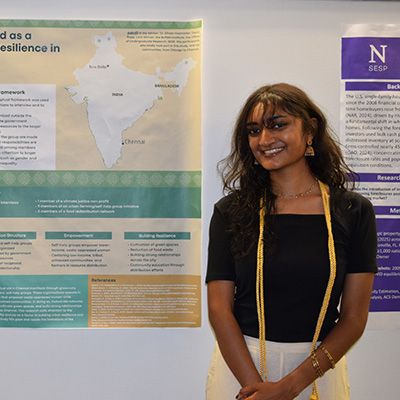 Anusha Kumar Naperville, Ill.
Social Policy / Environmental Policy and Culture / German / Civic Engagement
Advised by Elham Hoominfar (Sociology & Global Health) and Sneha Kumar
From Scarcity to Solidarity: Mutual Aid as a Pathway to Food Justice and Urban Resilience in Chennai, India
Supported by an International Senior Thesis Research Grant from the Buffett Institute for Global Affairs and an Academic Year Undergraduate Research Grant, Kumar traveled to Chennai to examine how community-led mutual aid networks help people access food and build resilience in the city. She found that communities — especially in the Global South — have long organized to take care of each other when governments fall short, and that tradition is alive and well in Chennai. In addition to navigating the logistics involved with an international research project, Kumar translated her interviews from Tamil to English. Read more about Kumar's Fulbright
 Anya Mateu-Asbury Brooklyn, N.Y.
Social Policy / Global Health / Data Science
Advised by Jen Munson (pictured at right) and Ofer Malamud (l)
Hunger and Learning: How Food Deserts and Food Insecurity Shape Academic Success
Mateu-Asbury will be pursuing a master's in public policy at the University of Chicago. Her thesis examined food insecurity in K-12 settings, finding that access to food alone doesn't predict academic outcomes — but that it "has meaningful consequences for students' learning and daily school life." "The results were not what I was expecting — I was thrown a lot of curve balls — but I'm glad I pushed myself. I learned a lot from doing research."
 Elizabeth Park Charlotte, North Carolina
Learning and Organizational Change / Economics
Advised by David Uttal and Mischa Fisher
From Foreclosure to Rental: Mapping Institutional Investor Activity in Single-Family Housing Markets Post-2008
Park is moving to New York City to join RBC Capital Markets as an analyst. Her thesis, inspired by an internship at a real estate investment firm, examined how large institutional investors have been buying up single-family homes — not to sell to families, but to rent them out, reducing supply, driving up prices and concentrating ownership. Analyzing markets in Atlanta, Charlotte and Jacksonville from 2009 to 2025, she found that investors heavily concentrated their purchases in lower-income, majority-Black neighborhoods that were already underserved. The pattern, she wrote, represented "a durable, structural transformation, as opposed to a temporary crisis response, with lasting consequences for homeownership access in the communities least equipped to absorb it."
 Shayna Tribush Needham, Mass
Social Policy / Integrated Marketing Communications
Advised by Lilah Shapiro and David Schieber (Sociology)
Policy and Perception: How Legislation Shapes Gen Z Attitudes Towards Sex Work in the Netherlands and the United States
Tribush received a Summer Undergraduate Research Grant to support her thesis, which examined whether legalizing sex work can normalize it in society — an idea that grew out of a class on the history of sex work during a study abroad experience in Copenhagen. She compared attitudes toward sex work among Gen Z women in the Netherlands and the United States, finding that participants from both countries held strikingly similar views despite living under opposite legal regimes.
 Shreya Wojno Chicago
Learning and Organizational Change
Advised by Lilah Shapiro and Julie Behrman (Sociology)
Missing from the Model: The Gender Imbalance in Undergraduate Economics at Northwestern University
Wojno will be working for Deloitte in New York City. She came up with her thesis idea — exploring what deters women from persisting in economics — while sitting in an econ class as a first-year student. "It was so different and almost jarring, so it just kind of stuck with me," she said. After winning an Academic Year Undergraduate Research Grant and completing a field research project with Professor Shapiro, she interviewed 16 undergraduate economics majors to better understand the leaky pipeline. She found several themes, including a culture that "structurally disadvantages female students through certain community norms and identity expectations" and an extracurricular environment often seen as more important than the major itself — one that, she wrote, "enforces a prevalent social hierarchy of 'acceptable' careers that skew toward male-dominated fields like finance and consulting."
