From Graduate Minds to Middle School Design
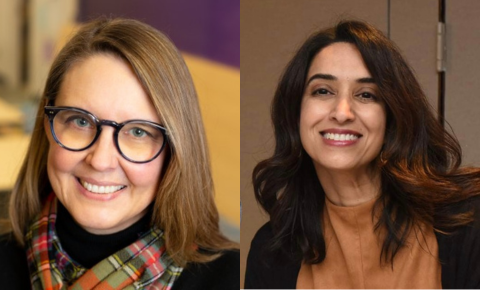
In 2024, the Montessori Unity Academy of Chicago partnered with graduate students in the Master of Science in Education and Social Policy (MSEd) Program to develop a forward-thinking curriculum for middle grade levels. As part of an independent study, graduate students led the Unity Curriculum Project under the guidance of Associate Professor Kavita Kapadia Matsko and senior advisor Christin Glodek.
Initially founded as an Islamic Montessori school serving students from pre-kindergarten through 5th grade, Unity Academy of Chicago – guided by its Board of Directors and Principal Arastu Minhaj – set out to expand its vision by developing a 6th grade curriculum to support students’ transition from elementary to middle school.
Their goal was to expand this curriculum to the upper middle school grades to prepare students for exams and honors curricula at local public and private high schools.
During the 2024 fall quarter, Kavita Kapadia Matsko, Associate Professor and Associate Dean for Teacher Education, was approached by Abbas A. Kanji, a Northwestern alumnus and member of Unity Academy Board of Directors, to build out the Unity Academy of Chicago’s middle school.
Their conversation marked the beginning of a collaborative effort to expand the school’s educational pathway and strengthen its long-term impact on students.
To bring the vision to life, Matsko partnered with Christin Glodek to co-lead an independent study composed of six highly motivated graduate students concentrating in Educational Studies or Learning Sciences within the MSEd program.
The team included Bayan Berdibay, Maya Kohrman, Haorui Li, Urshita Patel, Olga Vaskova, and Hemu Zhang. They were all “interested in curriculum development, but in different content areas," Glodek noted. Together, they formed the Unity Curriculum Project team, combining expertise and creativity to design a new middle school curriculum. With their efforts, the 2025-2026 academic school year marked the pilot year for implementing a 6th grade curriculum.
“It had to be rigorous; it had to be interesting,” Glodek emphasized. Grounded in the Montessori mission, which emphasizes student independence and positions teachers as facilitators of learning, the team viewed the initiative as a thoughtful and forward-looking approach to curriculum development.
The Unity Curriculum Project team began by learning about the school’s mission, values, and students before building the curriculum. They first asked:
- What is the Unity School community like?
- What are the values of Montessori education?
- What motivates students at the middle school level?
Working in curriculum content teams covering English Language Arts, Science, Social Studies, and Mathematics, the MSEd graduate students researched and designed curriculum materials. They reviewed notes from parent focus groups to understand what families wanted in a middle school, evaluated suggested curricula, and met weekly with students to hear their perspectives. Expert advisors with experience in curriculum development supported the graduate students throughout the process.
Research findings pointed to the importance of “primary and secondary sources, discussion, place-based learning, and culturally relevant materials,” to sustain the Islamic cultural values of the Unity School, Glodek said. Graduate students then shaped their work around multiple cultural perspectives and community engagement.
During the spring 2025 quarter, graduate students selected and presented curricula to the Board of Directors, comparing options within each subject area. The science team, for example, evaluated four programs—Amplify Science, OpenSciEd, TCI Science, and Project Lead The Way (PLTW) STEM.
Through this process, students identified how each curriculum addressed different learning entry points, teacher differentiation, and alignment with Unity's community values. Unity then hosted additional focus groups to share results and gather feedback before making a final decision with parents in the community about how to move forward.
“Our graduate students contributed to an authentic school need while furthering their own understanding of how to review as well as compare curricula” Matsko said. “The Unity experience allowed us to imagine different learning opportunities where students were connected with real organizations while supported by Teaching, Learning, and Education Program (TLEP) staff.”
“The feedback we received will continue to shape the Master’s Project for Educational Studies and Learning Sciences students,” she added.