Carrie Tzou Joins SESP Faculty
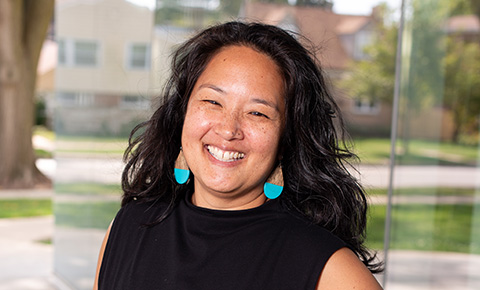
Alumna Carrie Tzou (PhD08), whose career has focused on helping students and educators feel connected to science and place-based learning, has joined Northwestern University’s School of Education and Social Policy as a professor of learning sciences and associate dean.
Tzou previously served as a professor of science education in the School of Educational Studies at the University of Washington Bothell and as director of the Goodlad Institute for Educational renewal. Her research examines how place and social context shape people’s experiences in science and place-based education across schools and communities.
“I grew up very curious about the natural world,” said Tzou, who was raised in Tucson, Arizona. “I spent a lot of time outside and learning about how our bodies, organisms and ecosystems work.”
That early passion faltered when Tzou arrived at college as a biology major and struggled academically for the first time.
“It was confusing -- science had always been my thing,” she said. “So I went to my adviser to ask why the teaching wasn’t better.”
His response was blunt.
“He said, ‘Here, the teaching doesn’t matter — just your research,’” Tzou recalled. “That was my 'aha' moment – that it wasn’t just me. It helped me understand the power of teaching.”
After graduating from Stanford University, Tzou taught middle school science and health for two years in the San Francisco Bay Area. She later earned a master’s degree in teaching and learning with a concentration in science education from Vanderbilt University before arriving at Northwestern in 2000 to begin her doctoral studies at SESP.
At SESP, Tzou met fellow graduate student Megan Bang, now the James Johnson Professor of Learning Sciences. The two have been longtime research collaborators. In 2021, they received a $1.8 million National Science Foundation grant to better prepare aspiring elementary school teachers in science, technology, engineering, and math.
The following year, they received another National Science Foundation grant to support Learning in Places, a project that creates hands-on, locally grounded science storylines for prekindergarten through fifth-grade students.
The lessons link science with reading, social studies and community lifeways and are designed with educators and families, drawing on nearby nature, family knowledges and practices, and local places as key resources.
“I’ve always tried to connect my teaching to students’ lives,” Tzou said. “But my own science education never addressed science’s ties to power, historical oppression or the promise of just futures. The work I’m doing now lets us design intentionally for those connections.”
Learning Sciences for Teachers?
For the past 15 years, Tzou has worked to bring learning sciences—an interdisciplinary field that examines how people learn—into teacher education.
“Learning sciences illuminate both the challenges and the rationale behind effective teaching,” she said. “We often emphasize how to teach, but not why we teach in certain ways based on what we know about learning.”
“Reconnecting with theories of human learning explains both what we do and why we do it,” she added. “As a teacher educator, part of my role is helping prospective teachers understand why schools and classrooms are such complex environments.”
Reflecting on her earlier career, Tzou said she would approach teaching differently today.
“I’d be more intentional about balancing an appreciation for how science helps us explore the natural world with a critical awareness of how it’s often narrowly defined in schools — and how we can broaden what counts as science,” she said. “I navigate that balance constantly with my preservice teachers now.”
In addition to research and teaching, Tzou will play a key role in revitalizing SESP’s Office of Community Partnerships, working closely with Evanston-area schools and building the capacity for trust, said School of Education and Social Policy Dean Bryan Brayboy.
“She understands how to connect with communities thoughtfully while remaining grounded in long-term research, partnerships and practice,” he said.
Tzou began that work shortly after arriving in August, partnering with Evanston/Skokie School District 65 as it faces significant financial challenges, strained community trust, and school closures.
“Professor Tzou has been incredibly supportive in helping us analyze community engagement data related to our structural deficit, now in its third and most challenging year,” said Superintendent Angel Turner. “She and her team attended every community session, collected and analyzed data, and coordinated a Northwestern team to assist. Throughout, they asked how best to support our work and walked alongside us every step of the way.”
The work, Tzou said, requires asking hard questions and thinking beyond immediate pressures.
“It requires deep community engagement, changes to institutional structures and a future-focused, data-informed approach,” she said. “That kind of work takes time because it depends on research and relationships. Community engagement has always been core to my career.”
A national leader in her field, Tzou has served on two committees of the National Academies of Sciences, Engineering, and Medicine’s Board on Science Education — one focused on preK–5 science education and another on equity in preK–12 STEM education.
She is a member of the National Association for Research in Science Teaching, the International Society of the Learning Sciences and the American Educational Research Association. In 2020, she received the University of Washington Bothell’s Distinguished Research, Scholarship and Creative Activity Award.
Further reading: