Seeing Social Policy Up Close in Bronzeville
When the bus stopped outside Parkway Gardens on a recent Saturday, Chicago historian Dilla explained to students how the complex went from one of the first cooperative housing options in a historically redlined area to being known as “the most dangerous block in Chicago.”
Parkway Gardens, more commonly known as O Block, was quiet that cloudy morning. The gated residential community had one entrance on that side of the block, guarded by a boom gate similar to a security checkpoint.
For the students on the bus — most from Professor Lauren Tighe’s Child and Family Policy class — the visit was more than a neighborhood exploration. The class was taking one of Dilla’s Mahogany Tours through Bronzeville on the South Side, connecting the policy they learned in the classroom with the communities those ideas shape.
Dilla, whose philosophy on LinkedIn reads, “Everything dope about America comes from Chicago, the greatest city on Earth,” provided an expansive tour of Bronzeville. Students visited the first Black church in Chicago, Quinn Chapel — a key stop on the Underground Railroad and for Southerners arriving during the Great Migration — and saw the childhood home of Emmett Till.
“I really was drawn to him [when selecting a tour],” Tighe said. “He’s like an everyman’s historian in that he is so knowledgeable, but in such an approachable way that it really resonates with people.”
Tighe’s class focuses first on what she describes as one of the nation’s “worst social ills”: poverty. Students learn about policies that address poverty including cash, food, healthcare, and housing assistance. The class then explores — through a critical lens — America’s primary approach to “solving” poverty: education policy across the lifespan.
“This field trip explores so many policy issues,” she said. “Dilla talks about housing. Bronzeville was the neighborhood where a lot of Black families lived after coming to Chicago from the South during the Great Migration and were purposefully kept in this area. There’s a lot of housing policy related to that.”
Rocco Cappelletti, a senior in the class from Chicago, said the concrete examples of how policy affects people “augmented the class.”
“When we passed by Parkway Gardens and had the conversation that there’s only one entrance when it stretches almost a half-mile long, that makes it difficult to access patients if you need to call an ambulance,” they said. “Looking at very specific cases and policies such as public housing helps a lot with understanding the intricacies of what we’re learning in class.”
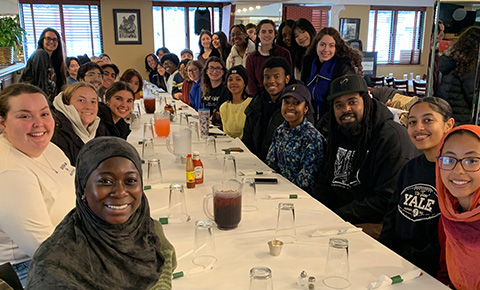
Beyond being educational, the field trip also serves as a bonding experience. Dilla’s tour includes humor — such as a story about a man who had the “testicular fortitude” to steal a police car from Chicago police headquarters — and the lunch at Pearl’s Place, where the class met Cook County Commissioner Bill Lowry, gives students a chance to get to know one another.
“I think it definitely improves classroom culture,” Tighe said. “Getting to be with other students and getting to know people outside the classroom and not talking about assignments is great.”
More than anything, the field trip offers students an opportunity to get out of their “North Side bubble,” as Tighe put it.
“Going to Bronzeville, just to get out of Evanston and get to the city and experience a new area, is great,” she said. “We get to see great history here, great food. Every neighborhood has a rich history and nice people and culture.”