Fungi: Web of Life
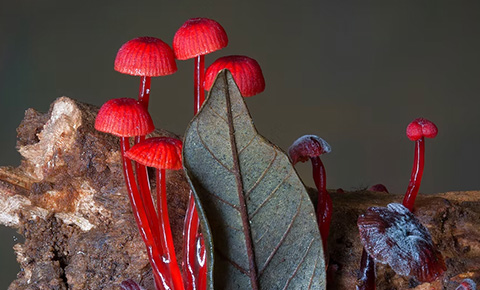 Fungi and their vast, unseen networks can teach us a thing or two about relationships and well-being, School of Education and Social Policy professor Carrie Tzou (PhD08) said after a free screening of the documentary “Fungi: Web of Life” in Northwestern University’s Annenberg Hall.
The movie follows British biologist Merlin Sheldrake as he travels the globe, exploring the secret world of fungi and their mysterious mycelial webs. Though invisible, these branching, thread-like structures have important lessons to teach humanity about survival through cooperation, Tzou said.
“Fungi remind us of the underlying systems of support that we might have or want to build and help us make connections with the natural world and each other,” she said. “As we learn more about how cooperation is such a driver in nature, it can help us feel less lonely.”
Tzou spoke with professor Claudia Haase at the event, part of the SESP Well-being Initiative. Haase, a developmental psychologist who studies emotions and healthy development across the life span, talked about the difference between fear and awe as the film showcased the strangely beautiful organisms through time-lapse cinematography.
The film underscored the educational power of the natural world, a key aspect of Tzou’s community-based research. In 2022, Tzou and SESP professor Megan Bang received a National Science Foundation grant to support Learning in Places, an outdoors, nature-based initiative that creates hands-on, locally grounded science lessons for prekindergarten through fifth-grade students.
For Tzou, there’s never been a more important time for humans to begin remaking relationships with the natural world, and the first step includes taking a dose of humility. “We don’t know everything,” she said. “If we continue to think about humans as apart from the natural world, the decision of whether to influence it becomes invisible. That's a detriment and a barrier when thinking about critical issues like climate change.”
The mycelium, which connect individual plants together to transfer water, nitrogen, carbon and other minerals, “teach us that thriving is not about just one person,” Tzou said. “It's about communities.”