When Yahtzee and Legos Add Up to Math
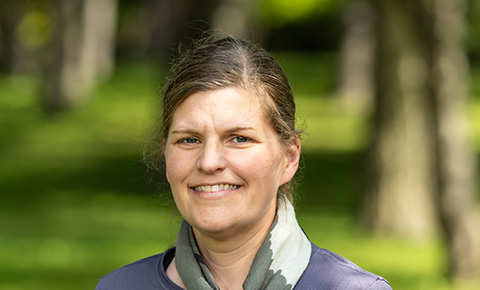
Northwestern University’s Jen Munson has received a five-year, $815,789 CAREER grant from the National Science Foundation to design spaces that make math as enjoyable as recreational reading.
Her project, in collaboration with Evanston/Skokie School District 65, challenges traditional views of math by offering playful, hands-on activities in after-school programs. When students see themselves as mathematicians outside the classroom — and teachers reinforce that message — they’re more likely to enjoy math and stick with it, Munson said.
“We want to redefine math to send the message that all students belong in the field, and that it can be joyful enough to do by choice,” said Munson, associate professor of learning sciences in the School of Education and Social Policy.
With National Science Foundation support, she will co-design math spaces at two local elementary schools and create a professional development community for teachers.
"If we view math as play, puzzling and building, does it shift how students see themselves and how teachers see the students?” she asked. “When students and teachers develop strategies through games and puzzles, those become resources for all kinds of mathematical thinking.”
In the United States, math is often viewed as mechanical, abstract and joyless. These beliefs — reinforced through instruction — have shaped generations of learners who describe themselves as “not a math person.”
Efforts to introduce new approaches are often constrained by classroom pressures, including testing demands and post-pandemic learning gaps. Even well-meaning parents may buy workbooks like Kumon as a “fun” supplement, but Munson said that mirrors the least engaging parts of school.
“Math can be playing Yahtzee, using a deck of cards or spending a Saturday morning with Legos,” she said. “If we let children know that being great at Legos also means they’re great at math, that could go a long way in supporting kids.”
Math anxiety limits learning
Despite decades of reform efforts, most classrooms still reward speed and accuracy. Students who do well are placed in advanced tracks, while those who struggle are given more time to practice and memorize procedures.
“In this view, some people are ‘math people’ and others aren’t,” Munson said. “These beliefs — held by educators and the public — shape how we design teaching.”
But the system, she said, is inherently flawed. “It produces a small group of fast replicators and a large group of students who believe their struggles mean they’re not math thinkers.” In both cases, most students lack deep understanding, and many develop math anxiety, further limiting their learning.
Munson seems math as creative, social and full of surprising connections. It’s less about getting the right answer and more about reasoning and exploring ideas.
“The reasoning processes students develop will carry them into real-world problem-solving,” she said. “To change teaching, we need to understand how teachers, learners and families think about math.”
Shifting an entrenched system requires long-term, multilevel efforts across teacher education, school leadership and professional development — all areas of focus for the School of Education and Social Policy.
A former teacher and math coach, Munson founded Multiplicity Lab, which uses visual tools and activities to help children see math in their lives. She co-authored the Mindset Mathematics curriculum with Jo Boaler and Cathy Williams and wrote In the Moment: Conferring in the Elementary Math Classroom.
“One key to shifting math instruction is changing what teachers and students believe math is,” she said. “If they see it as creative, flexible and collaborative, they’ll value one another’s contributions more — and that changes everything.”