Refreshing and Refining: A Review of SESP's Summer Learning Series 2025
 “The biggest effects on student learning occur when teachers become learners of their own teaching, and when students become their own teachers.” —John Hattie, Emeritus Laureate Professor of Education, University of Melbourne
Refresh. Learn. Connect.
These three pillars set the foundation for our journey at the Summer Learning Series (SLS), a three-day summer professional development series hosted by Northwestern University’s School of Education and Social Policy (SESP). The learning experience didn’t just provide deep and scholarly growth; it also wove personal wellness into each and every fold. Led by the talented team from the Teaching, Learning, and Education Program (TLEP), the mini-week began with a reminder of our ambitions and a reinvigoration of our passions, which involved embracing precisely what John Hattie illuminates: gentle self-reflection and an openness to new ideas and perpetual revision.
As a student in the Master’s of Education and Social Policy (MSEd) Program I have had many opportunities to contend with innovative educational theory, a myriad of multimodal and multidimensional instructional practices, and how to navigate the delicate interplay of the two. At SLS, I expanded upon these complex concepts through thoughtful engagement with new material and intentional learning from experienced educators, actively engaging in the practical integration of these ideas. Being able to sit and listen to the thoughts and cultured experiences from seasoned educators is an honor in and of itself; but to feel like I was able to offer a nuanced perspective because of my master’s preparation at Northwestern, was a separate honor in its own right.
 SLS allowed participants to pick from two of six options for professional development. The options included Cultivating Psychosocial Skills that Support Talent Development, Helping Students Make Sense of their World through Discourse, Mathematical Play: Exploring the Mathematics in Games and Puzzles, Computational Making + Digital Storytelling + Inquiry + Social Justice = Future Possibilities, Exploring the Ethics of AI, and Supporting and Sustaining Multilingual Learners. I attended Cultivating Psychosocial Skills that Support Talent Development and Exploring the Ethics of AI.
In the session, Cultivating Psychosocial Skills that Support Talent Development, led by the director of the Center for Talent Development, Susan Corwith, we discussed the biggest non-academic challenges facing our students today and how to help build their identities in tandem with their academic knowledge. Psychosocial skills are becoming increasingly crucial for the next generation to learn. Skills like empathy, emotional regulation, self-confidence, the ability to focus, and resilience offer students pathways to apply their academic and personal knowledge in their lives. By cultivating rich opportunities for students to learn more about themselves and their psychosocial potential, they increase their academic as well as their social abilities.
In alignment with these ideas, the MSEd Program offers the course Educating Exceptional Children, which focuses on designing for students with disabilities, as well as gifted and talented students. I felt the harmony between Educating Exceptional Children and Corwith’s presentation enabled the development of contemporary approaches for twice exceptional students (those who are deemed gifted and have disabilities/differing academic needs). This course stressed the importance of a childhood for our students and underscored the value of students having a life within and beyond school.
In my second session, Exploring the Ethics of AI with Charles Logan, who recently earned his doctorate in Learning Sciences and is now a post-doctoral research fellow at the Center for Responsible Technology, Policy, and Public Dialogue, I learned about the urgency behind pressing issues surrounding not only AI use in the classroom, but also AI use in general. In the beginning, we explored the history of AI, dating back to 1957. We discussed the risk of students’ cognitive dependence, an increased likelihood of academic misconduct, and the humanitarian issues that surround companies such as OpenAI, such as underpaying and traumatizing Kenyan employees, copyright infringement, and environmental concerns like excessive water usage.
We also discussed classroom strategies to contend with AI as a “solution looking for a problem,” as the esteemed Joseph Weizenbaum once characterized it in his 1985 interview with The Tech. There are aspects of this rapidly evolving technology that can—and should—be improved, but it’s clearly here to stay. This raises an important question: how do we adapt? Logan framed our thinking into finding “positive use cases.” As a team, we came up with ideas such as aiding students with hearing impairments, English Language Learners, and helping students connect with resources that are typically withheld by financial thresholds, such as resume writing, tutoring, and career coaching.
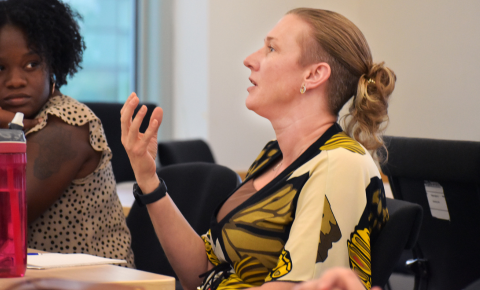 Regardless of where we stood on the contentious topic, Logan made sure that the room was filled with respect and acknowledgement. We were given the chance to create our own AI policies for our classrooms, which ranged from cautious inclusion to a complete ban. Having a space to discuss these pressing issues—for both our students and ourselves—allowed educators to find common ground and explore a range of AI resources. No decisions were made on our behalf, but by the end, we were well-equipped with the information needed to make our own.
The biggest takeaway from this experience, especially as a preservice teacher, was SESP’s depth of commitment to intellectual and physical wellness. Strong educators make for strong students, but every strong person needs an occasion to feel, heal, and get real every now and then.
The TLEP team intentionally centered these educators at the heart of their summer experience. Through the optional wellness walks, body scans, bookstore adventures, art exhibits, and connection to resources, the efforts made by the Northwestern staff were thoroughly considerate. The course offerings were engaging, applicable, and comprehensive, and the company was kind, thoughtful, and restorative. I sincerely look forward to attending the conference again, following my upcoming graduation in 2026.
Thank you to Kavita Kapadia Matsko, Caitlin Dunlap Sikes, Rebekah Stathakis, Brad Wadle, and the SESP staff for the invitation to attend. Thank you to each of the presenters for your hard work and care in planning these informative seminars. Additionally, I would like to thank my professors and instructors. There is no way I could have held my own in a space such as this without your incredibly supportive demeanor and excitingly rigorous expectations for the next generation of teachers.