Leading Change with Inclusion, Courage, and Global Perspective
 The question isn’t whether leaders should pursue equity and inclusion—it's how to do it skillfully when the ground keeps shifting amidst political, legal, cultural, and global pressures that are currently pushing organizations toward caution or retreat.
That was the central challenge explored in a recent webinar featuring Northwestern University’s School of Education and Social Policy faculty members Ritu Tripathi and Terrence Roche, both instructors in the Leading Equity and Inclusion in Organizations Certificate (LEIOC) program. What emerged wasn't a roadmap through easier times, but rather a clearer understanding of what this moment demands from leaders committed to building truly inclusive organizations.
Here are four insights—and actions—you can apply in your own practice:
Insight 1: Retreating from Equity Creates Strategic Risk—Not Safety
The faculty members spent time mapping how organizations are responding to the current moment—a period marked by legal challenges, political pressure, and an opportunity to re-shape what comes next for diversity, equity, inclusion and justice work in organizations.
Drawing on recent research from Catalyst and the Meltzer Center for Diversity, Inclusion, and Belonging, Roche presented data revealing how organizations are navigating competing pressures. The research identified three primary organizational responses:
Flight: Some organizations are retreating entirely, eliminating DEI roles, renaming programs, or simply going quiet. "Rolling back DEI disenfranchises younger generations," Roche observed. The Catalyst research reinforces this concern: 43% of employees say they will quit if their employer doesn't continue to support DEI, with rates even higher among Gen Z, millennials, and women.
Fight: Other organizations are doubling down, maintaining or even expanding (or fortifying) their commitments despite external pressure. These tend to be organizations with strong values alignment and leadership conviction.
"There's an opportunity to think critically about what has really been working and what we need to continue to push on, while considering what was merely performative and can be left in the past," Roche added.
Finesse: The majority are somewhere in between—adapting language, adjusting approaches, being more strategic about what's visible and what's embedded in core business practice. For example, 78% of C-suite and 83% of legal leaders according to the Catalyst research—are "rebranding" DEI programs with terms like employee engagement, workplace culture, or belonging while attempting to maintain substantive commitment.
Actions for practitioners:
- Anchor equity in strategy—not politics or sentiment
- Clarify which elements of your equity work are evolving and which values and practices remain non-negotiable
- Build internal literacy around the risks of retreat and the long-term business costs of abandoning equity commitments
- Identify opportunities to fortify high-impact initiatives rather than simply defending or scaling back
- Monitor the perception gap: how leaders think they're acting vs. how employees and stakeholders interpret those actions
Insight 2: True Inclusion Requires Both Belonging AND Uniqueness
Roche shared a framework that reframes how we understand inclusion itself—not as a single dimension, but as the intersection of two critical needs: belongingness and uniqueness.
Drawing on research by Shore et al. (2011), Roche presented a 2x2 matrix that reveals four distinct employee experiences:
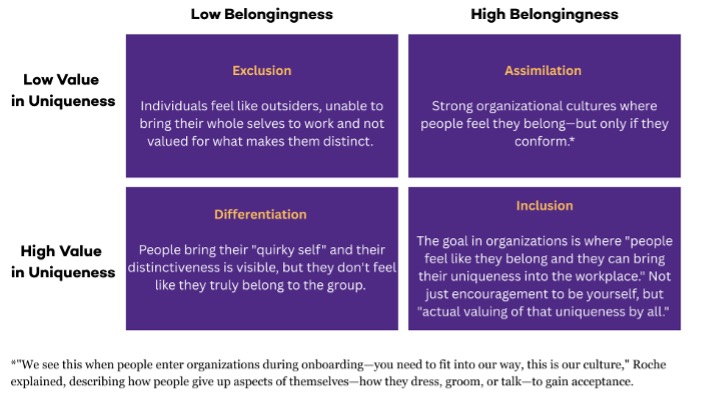
Tripathi connected this framework to broader societal questions: "Is the society a melting pot where everyone's identity and uniqueness is just getting blended? Or is it a salad where you can taste and see the unique piece of that carrot or the pea, but nonetheless, that salad itself looks beautiful as a whole?"
This framework reveals why many diversity initiatives fail—they focus solely on belonging (getting people in the door and then working to make them “fit-in”) without creating space for people to be authentically different. True inclusion requires a valuing of both dimensions—belongingness and uniqueness—simultaneously.
Actions for practitioners:
- Audit your organization across both dimensions: Do people feel they belong? Can they express their authentic uniqueness?
- Identify which quadrant different employee groups occupy—the answer may vary by identity, role, or team.
- Examine where assimilation pressure exists: What unspoken expectations require people to downplay difference to fit in?
- Create systems that actively value uniqueness, not just tolerate it—in decision-making, meetings, performance reviews, and informal interactions.
Insight 3: Without a Global Lens, Local Inclusion Efforts Stay Incomplete
Tripathi extended the macro-forces narrative by noting that in an era of geopolitical tensions and tariff wars, skepticism about globalization is natural; many may wonder how much do topics such as cross-cultural competence or global diversity matter in current times.
She pointed to data from the 2024 DHL Global Connectedness Survey showing that global flows remain remarkably resilient, challenging the popular deglobalization argument. She also emphasized that understanding local cultural dynamics is essential for multinational organizations.
Drawing on her award-winning co-authored teaching case, she illustrated how even well-intentioned HR initiatives—such as paid parental leave introduced by a U.S.-headquartered company—can face resistance when local cultural norms are overlooked.
Globalization creates both opportunity and exclusion. Migration patterns, digital connectivity, and economic interdependence mean that even local hiring practices or organizational cultures reflect global power structures.
Leaders need to understand how systemic biases and cultural dominance show up in their own organizations' assumptions and practices. Even organizations without international operations are influenced by global economic patterns, migration flows, cultural norms, and digital networks.
Actions for practitioners:
- Develop cultural intelligence alongside technical and strategic skills
- Examine how global inequities show up in local policies, talent pipelines, or organizational assumptions
- Ask: If our inclusion efforts had to hold across multiple cultural contexts, what would we reimagine?
Insight 4: Bias Travels Through Systems Unless Intentionally Interrupted
Rather than offering simple solutions, Tripathi and Roche shared frameworks that help leaders navigate complexity—with a critical warning: bias doesn't disappear when new systems are introduced. It becomes embedded via societal dominant norms unless intentionally disrupted.
Whether through AI tools, performance evaluations, or informal power structures, inequity spreads through whatever systems carry it. Performance systems don't automatically become fair just because they use data. AI tools don't eliminate bias—they can encode and scale it. Conversely, you can actively train AI tools to be inclusive and in doing so you may find they are more objective than humans who hold bias.
The work isn't about implementing the perfect program, the instructors emphasized. It's about building organizational capacity to see clearly, respond thoughtfully, and adapt continuously.
Actions for practitioners:
- Conduct equity reviews of data-driven decisions and technology, including AI systems used in hiring, performance evaluation, and talent management
- Ensure datasets used for training AI algorithms represent diverse populations across age, gender, race, and other demographics—and establish review processes to continuously monitor outputs
- Map how power operates—formally and informally—and how identity shapes influence
- Normalize questions in decision-making processes, like: Who benefits? Who is burdened? Who is missing?
- Treat equity as requiring ongoing vigilance, not one-time implementation
Why Does Inclusive Leadership Matter Now More Than Ever?
According to the Roche and Tripathi, leading inclusively in this moment means:
- Seeing systems clearly enough to design them differently
- Making values-based decisions even under pressure
- Understanding how one's own identity and experience shape leadership approaches
- Building cultures where psychological safety and high performance reinforce rather than contradict each other
Despite—or perhaps because of—the difficulty of this moment, Roche expressed optimism about what's ahead.
"It's been a very difficult year for DEI practitioners or anyone that cares about DEIJ," he acknowledged. "But it is an incredible resurgence in resolve... we're going to figure this out and take the opportunity to come out with something even stronger and better than what we had before."