Capstone Spotlight: Building AI-Ready, Human-Centered Leaders
 Kara Alhadeff Roseboom’s Capstone research sits at the intersection of learning, technology, and human capability—an area where MSLOC’s emphasis on human-centered design, reflective practice, and adaptive leadership becomes especially powerful.
Her story—and her research—demonstrate what happens when MSLOC learners combine rigorous inquiry with the faculty guidance, cohort support, and applied practice that define our community: they create insights that advance their careers, influence their organizations, and push the field forward.
Kara shared, “MSLOC transformed my career. I shifted from education into a tech startup at the forefront of learning, grounded in human-centered principles that shape how I lead change. Completing the program while working full-time and starting a family affirmed that I can take on hard things and thrive. I’m endlessly grateful to the professors and peers who shaped this journey.”
__________________
AI is transforming how individuals learn, work, and grow. While enthusiasm for AI is high, actual adoption in Learning and Development (L&D) remains inconsistent. Many professionals use AI to generate content or automate tasks, but few are harnessing its full potential as a collaborator.
When I began my capstone, I noticed a disconnect everywhere: L&D leaders talked about AI’s promise but struggled to meaningfully integrate it into their workflows. The issue wasn’t technical proficiency. It was human capability, specifically the mindsets and skills needed to partner effectively with AI.
The Problem
According to research conducted by L&D expert, Donald H Taylor, AI has become the top priority for global L&D functions (2025), but the shift from tool to teammate requires a new way of thinking and working—one rooted in adaptability, experimentation, and critical thinking. If L&D leaders can’t strengthen these capabilities themselves, they’ll struggle to help their organizations develop them at scale.
The Research
To explore this gap, I conducted a survey of 45 mid- to senior-level L&D leaders and completed six interviews across role levels. I wanted to identify which human capabilities predict AI adoption and understand how leaders are learning to work alongside intelligent systems.
My study centered on four core capabilities that consistently emerged as critical across the 2025 World Economic Forum report and multiple peer-reviewed studies.
- Adaptability: adjusting quickly to new conditions
- Learning agility: acquiring and applying new knowledge rapidly
- Critical thinking: evaluating and refining information and outputs
- Human-machine collaboration: co-creating solutions with AI, not just consuming them
My study resulted in three key findings:
Key Finding 1: Adaptability and Human-Machine Collaboration Drive Adoption
From my survey, I found that adaptability and seeing yourself as co-creating solutions with AI (human-machine collaboration) were the strongest predictors of AI adoption, see Figure 1 from the study. Leaders who adapt quickly and actively co-create with AI were far more likely to integrate it effectively. Those who waited for “perfect clarity” often fell behind.
Interviews brought this to life. One leader described AI work as “jumping in and figuring it out,” while another said, “You’re not going to get it right the first time you prompt.” The best adopters experimented, iterated, and learned by doing.
Key Finding 2: Learning Agility Builds Adaptability
Learning agility, defined as the ability to learn, unlearn, and relearn, proved to be the fuel for adaptability, being a statistically significant predictor (see Figure 1). It revealed itself in action through curiosity, reflection, and structured experimentation. Leaders who set aside time to test AI tools on real projects became more adaptable and confident over time.
Key Finding 3: Critical Thinking Keeps Humans in the Loop
Critical thinking emerged as the protective capability that preserves both quality and ethics in human-machine collaboration. Leaders who consistently questioned AI’s assumptions, validated its outputs, and aligned them with learner needs reported stronger outcomes and greater confidence in their work. As one leader put it, “The work means nothing without my brain and my expertise in instructional design,” highlighting the distinctly human role required when working with AI. Others echoed this sentiment, noting that “AI demands L&D leaders to become the expert, not defer to one,” shifting authority and accountability squarely back to the human professional.
Implications for L&D Leaders
This research reinforces that AI success depends less on technology and more on human practice. L&D leaders should:
- Adopt an exploratory mindset—replace perfectionism with curiosity.
- Create structured time for AI experimentation.
- Be the human in the loop—critique, refine, and guide AI outputs.
- Reflect and share lessons through communities of practice.
Why This Matters
For professionals leading in an AI-enabled workplace, this shift is both exciting and daunting. The message is clear: you can’t delegate adaptability and critical thinking. It’s something you build through practice. And in fact, AI doesn’t erase the need for human intelligence—it demands more of it. The future belongs to leaders who can experiment with confidence, think critically about automation, and co-create with technology in ways that amplify human value.
Interested in reading the full study? Click here.
Figure 1
Adaptability and human-machine collaboration are the two key human capabilities that Learning and Development leaders need to adopt AI.
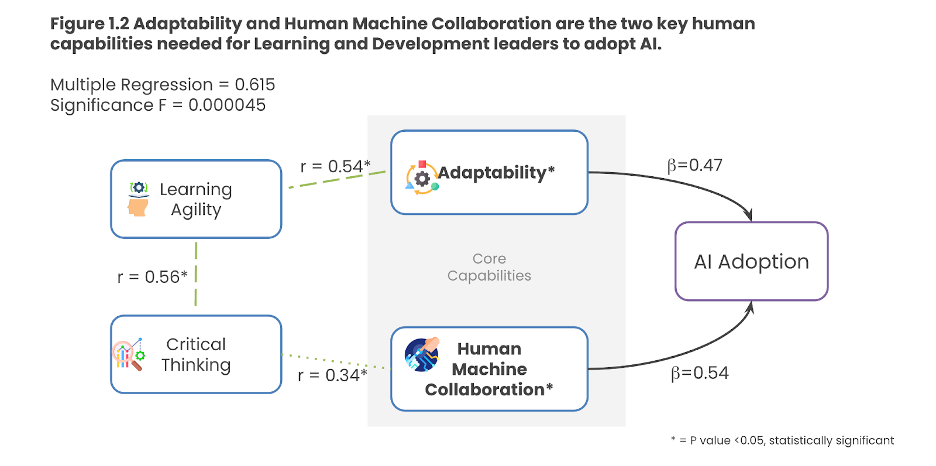
Figure 3.3
Experimentation, A Key Component of Learning Agility, Develops Adaptability
References
Taylor, D. H. (2025). The L&D Global Sentiment Survey 2025 (Version 2.1). Donald H Taylor
Services Limited. https://donaldhtaylor.co.uk/research_base/global-sentiment-survey-2025/
World Economic Forum. (2025). The Future of Jobs Report 2025. https://www.weforum.org/publications/the-future-of-jobs-report-2025/