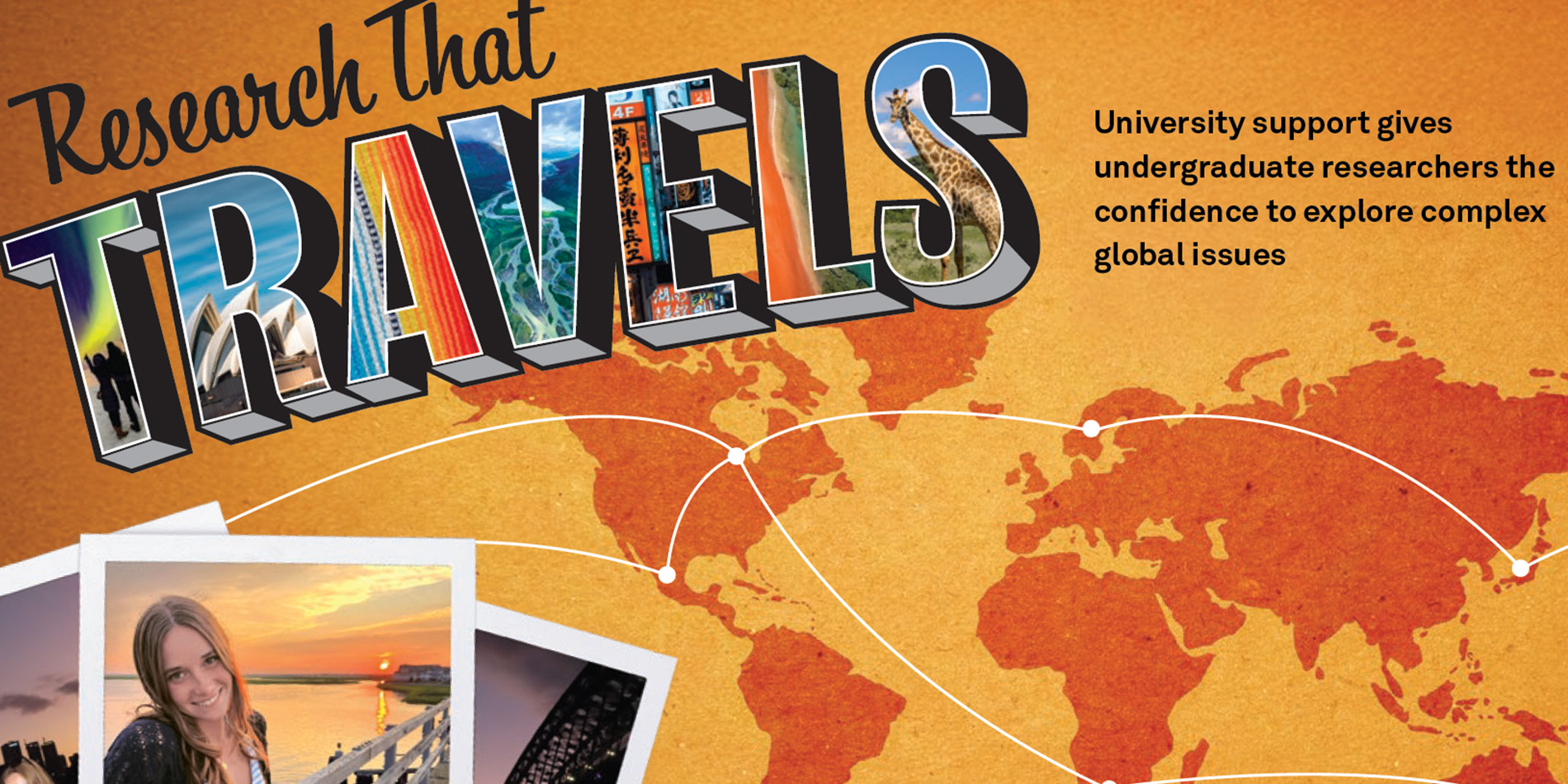
Research That Travels
Undergraduate Juniper Shelley once thought the "cool" research only happened in cold, windowless STEM labs.
But after joining Professor Sally Nuamah's research team, she realized it could involve nearly everything she loves: traveling, talking to people, and exploring challenging questions.
Shelley, a SESP junior, will take that work global this summer after winning Northwestern University's highly competitive $10,000 Circumnavigators Travel-Study Grant. Her project involves traveling to Mexico, South Africa, Sweden, Japan, and Australia over 10 weeks to study how men in different cultures experience loneliness, masculinity, and emotional connection. It's a dream adventure for Shelley, though she isn't necessarily planning a career in research.
"If you have a wide range of interests, undergraduate research is a fantastic way to pursue academic passions without having to take classes or declare a major," she says. "Research doesn't need to look like working in a lab on campus."
Shelley is one of countless SESP undergraduates who came to Northwestern with little understanding of what research entails and are now enthusiastic advocates. Through course-based research, senior honors theses, University grants, and faculty labs, students gain experience working alongside world-class scholars while building skills, confidence, and professional networks that last long after graduation. Students say research pushes them beyond their comfort zones, teaching them to navigate uncertainty, adapt when plans change, and take responsibility for complex projects.
"In the beginning, it is totally overwhelming, but it gets better and you settle in," says Jonathon McBride (BS16), a 2015 Circumnavigators Grant recipient who is now an anesthesiology resident at the University of Michigan. "At each site, I got better at asking questions, I got better at researching, and I certainly got better at traveling." He studied sexual assault policies and student support resources at universities in Brazil, Spain, the Netherlands, Turkey, South Africa, and Australia for a project that grew out of his work as president of Northwestern Men Against Rape and Sexual Assault.
"The Circumnavigators Grant really changed how I think and approach everything," says McBride, who plans to specialize in pediatric anesthesiology and was recently awarded a clinical fellowship at Stanford University. "It's not just about research—getting through challenges while traveling solo gives you tremendous confidence that you can handle whatever life throws at you."
Curiosity across continents
Shelley, of Montclair, New Jersey, first began in Nuamah's lab studying how Black girls are disciplined in Chicago Public Schools. She also completed an independent research project examining how immigration status affects interactions with the healthcare system. She began thinking about the emotional lives of men after seeing social media posts about the male loneliness epidemic and reading Boys and Sex by Peggy Orenstein. "The scale of the problem really struck me," she says. "There weren't many solutions."
As she prepared her Circumnavigators proposal, Shelley sent more than 100 emails and spoke with at least 20 members of the ManKind Project, an international nonprofit that facilitates men's groups in more than two dozen countries. Houssine, from Belgium, told her about turning to drugs instead of confronting his failing marriage. Fernando, from Mexico, admitted he never learned to identify emotions beyond anger. Rob, from Japan, recalled how isolation led to suicidal thoughts in high school.
Shelley quickly noticed that men from countries with vastly different cultures of masculinity described similar feelings of isolation. "Hearing how deeply these patterns affected men's mental health made me want to understand not only the problem, but what kinds of community-based solutions actually help," she says.
For her project "Rewriting Manhood: Cross-Cultural Approaches to Male Connection and Growth," Shelley will interview group leaders in each country she travels to and collect observational, survey, interview, and focus-group data. Talking to people is her favorite part of the research process and a skill she expects to use wherever she lands.
Conversations across cultures
"I like the type of research that relies on other people's expertise to answer challenging questions," Shelley says. "Support from the Circumnavigators Grant lets me learn from people all over the world and understand how their unique experiences help answer very complex questions."
Shelley hopes to pursue a career in international aid after graduate school, where research will follow her for years to come. For those who want to pursue research as undergraduates, she suggests starting with a big idea and being "open-minded to changing your approach as you go."
"This project is certainly not what I imagined I would be working on when I began researching the topic," she adds. "But the conversations I had with members of the ManKind Project were some of the most engaging I've ever had. I'm excited to talk to them in their own countries and to see firsthand how, where, and why the program works."
By Julie Deardorff