Fighting to Connect
Why Sara Shacter believes talking across differences matters
By Julie Deardorff
After the 2016 presidential election, Sara Shacter (MS90) felt the need to get out of her blue bubble. Could so many people really have a different set of values than she did? When she learned a friend's husband leaned conservative and loved talking politics, she invited him out for brunch.
A decade later, Shacter—an educator, writer, and children's book author—still regularly meets up with Jerry Patt, a retired math teacher. They debate immigration, gun rights, and climate change, but one thing they agree on is that their conversations are crucial for a healthy democracy.
"Sara is a remarkable individual," Patt says. "We couldn't be more diametrically opposed politically, but she's very thoughtful and we never argue—we just discuss things. If other people got together like we do, there wouldn't be so much political polarization."
A bridge between blue and red
Connecting with others, especially those with different perspectives, is at the heart of Shacter's work, whether she's volunteering for an organization trying to bring civil discourse back into American politics or writing children's books with themes of belonging. Everyone can help bridge our country's divides, she says, not necessarily by reshaping opinions on issues but by changing how we see one another. The key is to remember that the call to "fight hard" can obscure the necessity to "fight soft." We must work to understand the reasons behind disagreements. "That's how you find overlap," she says. "And in some cases, it's the only way to move forward."
Shortly after reaching out to Patt in 2016, Shacter discovered the Illinois chapter of Braver Angels, which facilitates structured conversations, workshops, debates, and public presentations between liberals (called "blues") and conservatives ("reds"). As a volunteer, Shacter has been instrumental in arranging events and reaching out to reds so there is a balance of viewpoints, says Chicago's Maryanne Colter, the blue-state coordinator for Illinois.
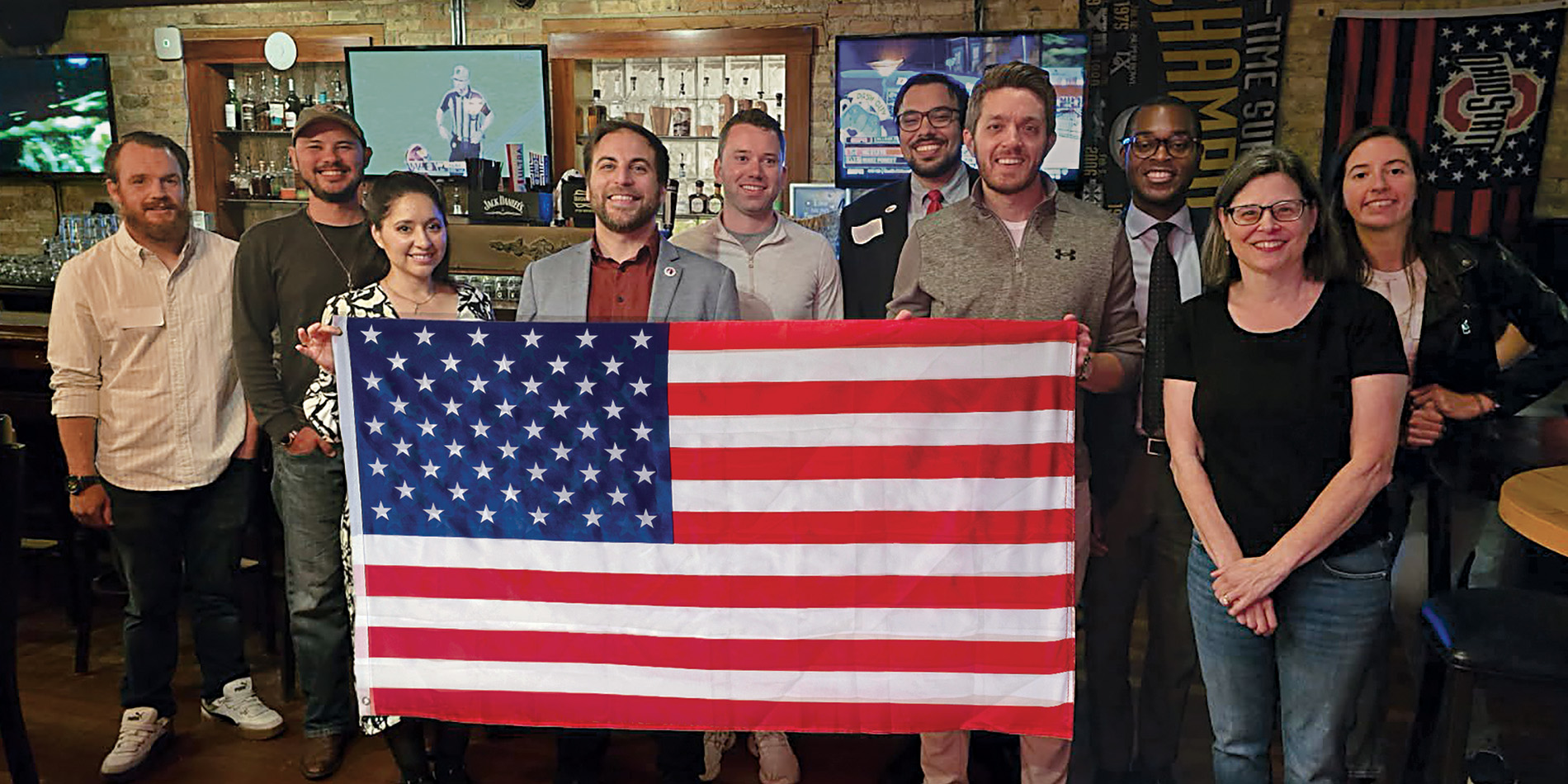
Shacter is also working on a program to bring the Braver Angels approach to nonmembers, an idea piloted last September with the Chicago Young Republicans. A group of blue Braver Angels attended the Young Republicans meeting for what was supposed to be an hour of conversation. Instead, it lasted three hours, Colter says, and twice as many Young Republicans showed up than expected—surprising, since Turning Point founder Charlie Kirk had been assassinated the day before.
"They passed up attending candlelight vigils to come talk to us," Colter says. "By the end, we found things to agree on—including the value of education—and it never would have happened without Sara being diligent and determined and saying, 'We're going to do this.'"
Shacter was also part of the Braver Angels team that worked on an initiative to send red Angels to the 2024 Democratic National Convention in Chicago and blues to the Republican convention in Milwaukee. In common ground workshops, which bring together equal numbers of conservatives and liberals for a deep dive into issues like climate change, electoral reform, or abortion, Shacter is the one who can bring the temperature down. "She believes in face-to-face conversations and reaching across the aisle, even if she vehemently disagrees," Colter says. "What she does doesn't capture it. It's who she is."
More alike than we think
Shacter knew she wanted to be a teacher and writer from a young age. An avid reader—she devoured Judy Blume's books—she also loved to write and penned a letter to the editor in eighth grade. After studying English and psychology at Tufts University, she spent a year as a teacher's aide at Waukegan (Illinois) East High School before earning her master's at SESP. She then taught high school English for a decade in Park Ridge, Illinois, while also working on children's books, inspired by a class she took after college.
Her debut middle-grade novel, Georgia Watson and the 99 Percent Campaign, teaches that most unkindness comes from other people's unhappiness, exploring the importance of connection that parallels her work with Braver Angels. The book can be used as a springboard for both reading and social-emotional learning instruction, Shacter says. "Georgia feels alone and believes her nemesis is simply a nasty person. But when she starts to look at the why behind her own loneliness and the why behind her nemesis's attitude, she begins to see that there's another story."
While working on the book and researching heredity, she fell in love with the idea that we're all more than 99 percent the same in terms of our genetic material. "We're unbelievably similar on such a deep level," she says, "and that's important to remember, especially now." Shacter has returned to the classroom through author visits, discussing with students such topics as genetics and heredity, the power of human connection, and the importance of believing in yourself.
In addition to her continued meetings with Patt, she likes to strike up conversations with anyone who seems to hold an opinion at odds with her own. She's learned that what seems ignorant or mean-spirited on either side is often rooted in the fact that we're simply not hearing the same things from media sources.
She's also found that she and Patt often disagree for the same reason. "We might argue about immigration policy, but because we both want things to be fair. We might disagree about gun control, but because we both want people to feel safe. I started to see that when you get down to the why regarding someone's beliefs, the context of the story shifts."
People in her bubble will often tell Shacter, "You talk to them? I just couldn't do it." Her response? "If you decide to try, I bet it won't be what you think. Connection is key if we are to solve the pressing issues in our world."
For more, read "Citizenship is a Skill."