A Professor and a Comedian Walk into a Bar
What can comedy teach us about open dialogue and free speech in higher education?
By Dan Perlman
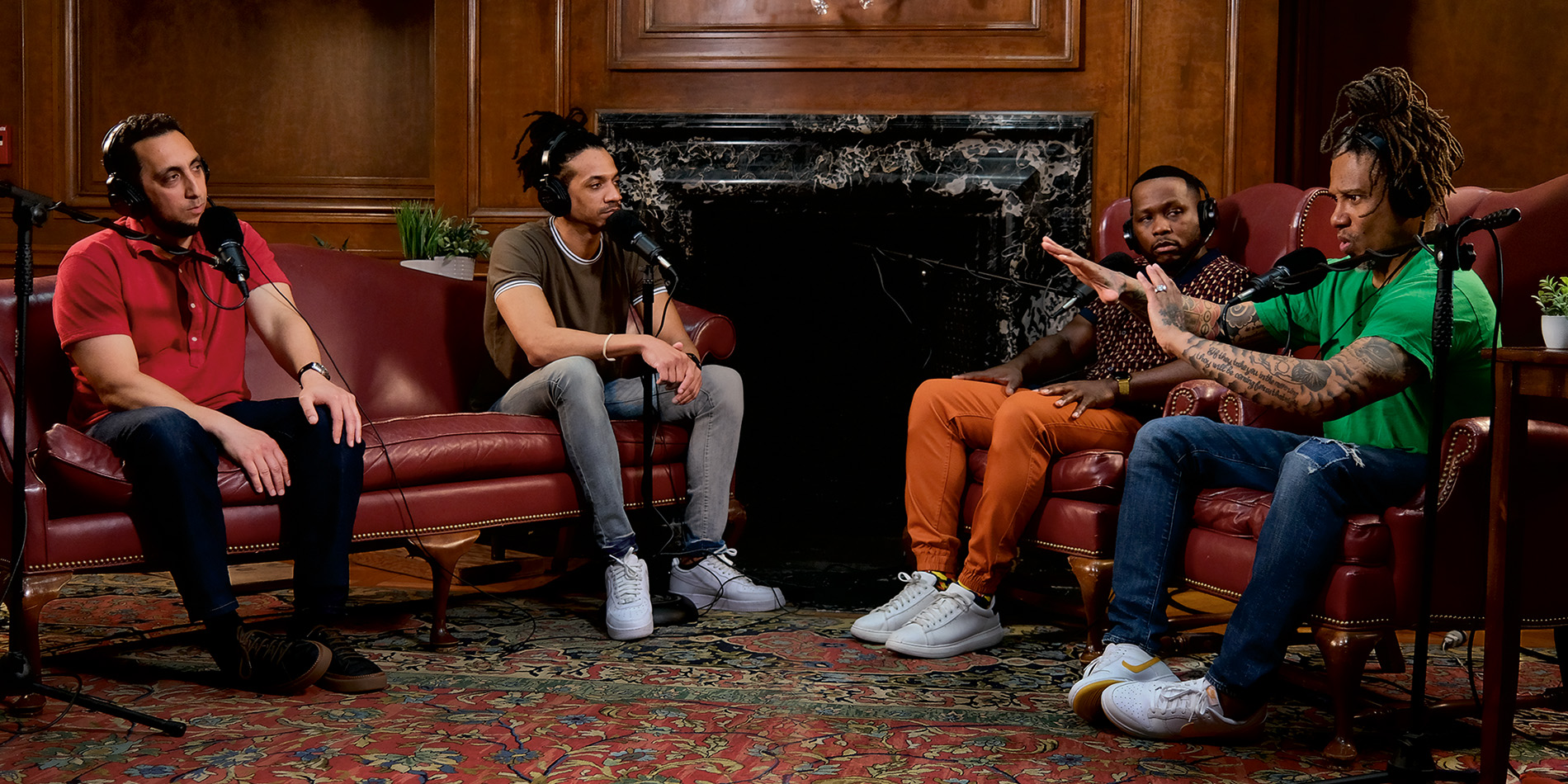
In a world where academics and stand-up comics rarely share the stage, the podcast A Professor and a Comedian Walk into a Bar, which launched in November, is doing something unusual: mixing scholarly insights with humor.
Hosted by SESP professor Sepehr Vakil and Chicago comedian and producer Mike Knight, the podcast is a platform for open dialogue at a time when some comedians are avoiding college campuses and critics say cancel culture stifles open and vigorous debate on complicated topics.
“Comedy is often viewed as antithetical or even heretical in academia,” Vakil wrote in an essay for The Los Angeles Review. But the culture of comedy, he argues, offers much-needed advice to supporters as well as detractors of higher education on how to listen and engage across political and ideological differences.
Produced by filmmaker and DePaul University professor Raphael Nash, the podcast pairs professors with comedians for smart, funny, honest conversations on a wide range of topics.
But the format is flexible—after the 2024 presidential election, Vakil and Knight skipped having guests in favor of a candid one-on-one discussion about the election results and the stark contrast in how their fields engage with difficult subjects.
“Comedians name the elephant in the room,” Vakil says, in contrast to the more reserved, formal nature of academic discourse.“And Mike Knight, with his background in stand-up, is the one who can pull out insights from our academic guests in ways that are revelatory and insightful.”
One episode paired comedian Sonal Aggarwal, a self-described “world traveler, bridge builder, and maker of mischief,” with Loyola University Chicago professor Katherine Cho, an expert on student activism. The two discussed who has more freedom when it comes to discussing topics like Middle East politics: comedians or academics.
Guests often start by emphasizing their differences but “end up discovering a lot of overlap,” says Spencer Thomas, who’s studying radio, television, and film at Northwestern. Several other undergraduates work behind the scenes, filming for YouTube and helping with logistics and postproduction.
Among the podcast’s goals is making academia more accessible. “I don’t think the broader public really gets us,” Vakil says.
An associate professor of learning sciences who’s long incorporated storytelling and qualitative research into his work, he hopes the show will offer a way to connect with audiences and regain public trust in science.
Using comedy to relate is a newer approach, but when Vakil heard comedian Roy Wood Jr. call it “a form of journalism —living anthropology in its highest form” on National Public Radio, he thought, “Exactly.”
His admiration for comedy prompted him to try improv and a few open mics himself at the Red Room in Chicago’s Rogers Park. “It’s terrifying,” he admits, but it’s also a way to experiment with a new mode of writing and speaking.
Embracing comedy in academia won’t be easy, Vakil acknowledges, and requires walking the tightrope of simultaneously respecting speech and people. “It will require recalibrating the concept of safe spaces,” he wrote in his article. “It means learning to be more comfortable with discomfort and renegotiating the academy’s relationship with the broader public.”
But the payoff, he says, is well worth the work. “You don’t always have to agree with the premise or laugh at the punchline, but good comedy will always make you think. And that’s precisely why it’s so needed in academia.”
Listen to A Professor and a Comedian Walk into a Bar.
Photo from left: Vakil and Knight record a recent podcast with comedian Calvin Evans and University of Illinois Chicago professor David Stovall.