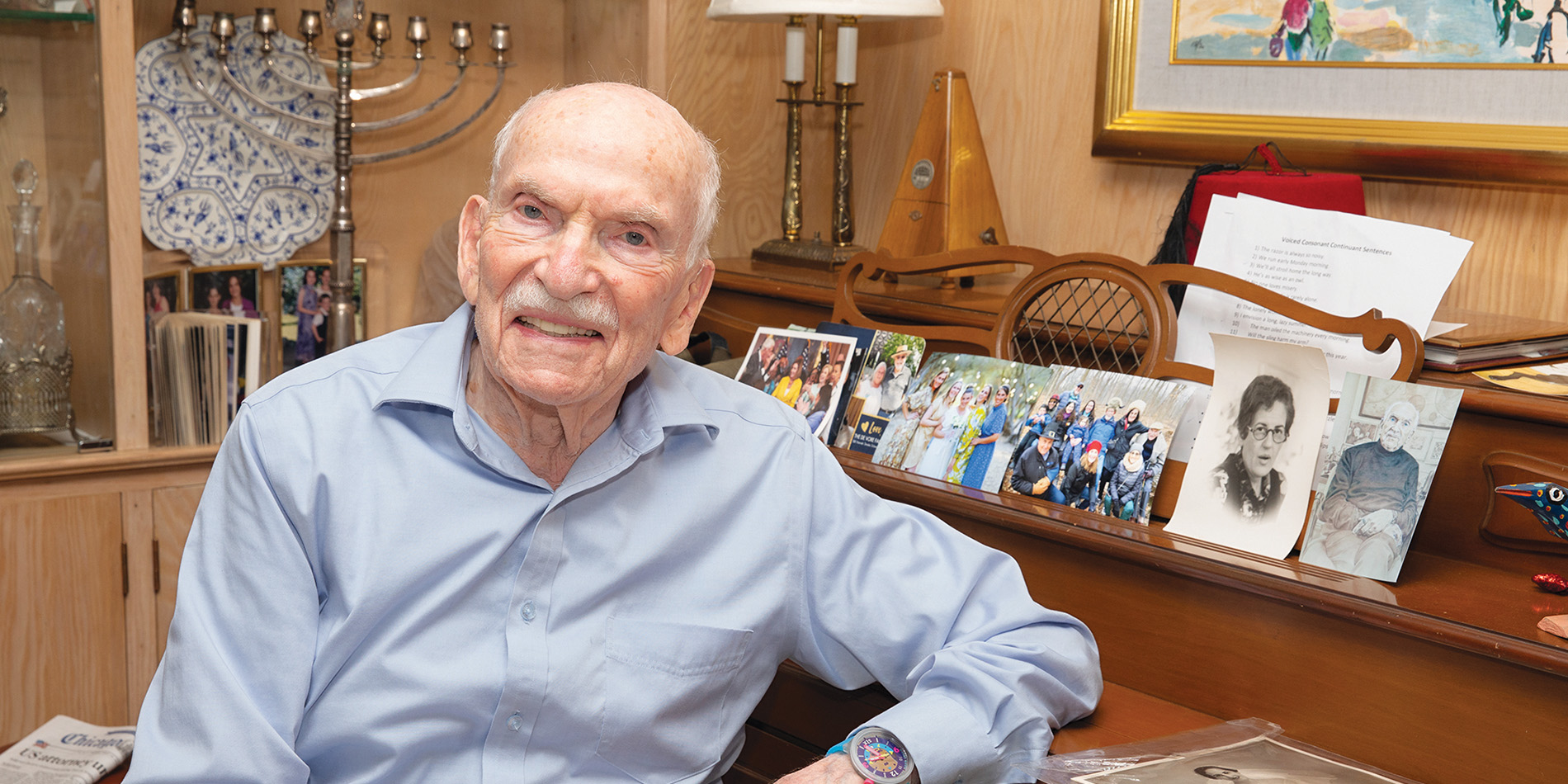
Stil Learning, Still Leading at 100
Krumbein's work in equity and school integration reflects lifelong commitment to social responsibility and community well-being
Eliezer Krumbein (MS56, PhD60) isn’t quite as tall as he once was, and he conserves energy by running on “low-power mode,” sneaking in occasional naps during the day. But like SESP, he turned 100 this year, and despite the trials that come with being a centenarian, Krumbein is going strong.
A lifelong educator who championed school desegregation strategies in the 1960s, Krumbein still works as a clinical psychologist, seeing up to five people a day and usually working 12 hours a week. He exercises regularly, drives, lives on his own in the Chicago suburbs, and takes continuing education classes in psychology.
“He’s an optimist and forward-thinker,” says his daughter Debbi Dworin, noting that when her father was 85, he decided to get braces. “I find it remarkable that he always manages to identify something new he’s learned, even though he has taught or could teach most of the classes he’s sitting in on. He comes with both openness and humility.”
Those traits—along with a prodigious memory and an ebullient nature—have characterized Krumbein throughout his life. Before pursuing his doctorate at Northwestern in the 1950s, he worked in race-relations education for the Anti-Defamation League and served as director of religious education at a large synagogue.
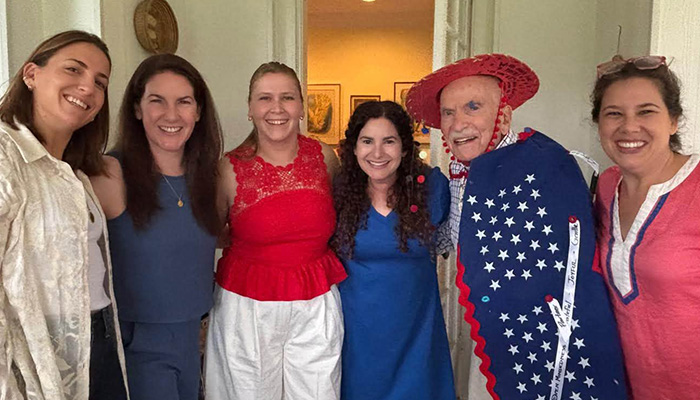
He later became director of education for Northwestern’s Transportation Center and an assistant professor at what was then the School of Education, teaching educational history, philosophy, and psychology. In 1967 he joined the University of Illinois Chicago as an associate professor in the College of Education before leaving academia in the early 1980s to practice psychology full-time.
“Eli was like a father figure to me,” says Frederick Erickson (PhD69), who met Krumbein in the 1960s and shared an office with him at UIC in the 1970s. “He personified a consistent commitment to justice while recognizing that it’s not necessarily an easy path.”
Working on educational justice issues in the ’60s, Krumbein, Erickson, and Armin Beck (BS56, PhD66) coauthored “Strategies for Change: Conditions for School Desegregation,” published in the Phi Delta Kappan. They argued that simply placing children of different races in the same classroom wasn’t enough—curricula and school culture needed to change too. “Racial antipathy and violence can result from the kind of desegregation that results in the creation of merely biracial schools,” they wrote.
When people read the article today, “they say, ‘Wow, you guys were really onto something back then,’” says Erickson, now professor emeritus of education and anthropology at the University of California, Los Angeles.
Formative years
Born in 1926 in Brooklyn, Krumbein began his elementary schooling shaped by psychologist John Dewey’s progressive education movement. In third grade he started attending a Jewish religious school, learning Hebrew and diving into Jewish culture.
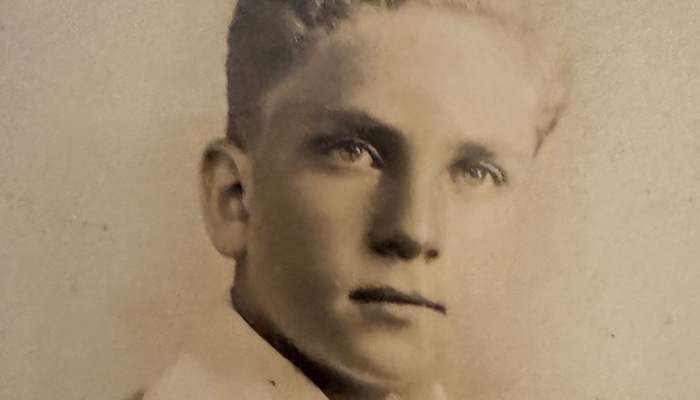
After graduating from Harvard in 1946, Krumbein came to Chicago for graduate work and met the love of his life, the late Elaine Frohman (WCAS46), while working for the Anti-Defamation League. Shortly after they married in 1950, Krumbein was working 90 hours a week as principal of a religious school and teaching adult classes such as Ethical Implications of World Religions.
“Elaine would do the reading for me, stay a couple weeks ahead, teach me the stuff, and then I would go back and teach it,” he told his granddaughter Sarah-Bess Dworin in a StoryCorps interview at age 93.
Krumbein fondly recalls mentors like longtime faculty member Joe Park, who helped design Northwestern’s first doctoral program in education and philosophy in 1953. He still visits the grave of Franklin Kreml, founding director of Northwestern’s Traffic Institute and Transportation Center, for whom Krumbein designed an integrated master’s program in transportation. The program drew on experts from eight departments across the University.
In 1964, Krumbein participated in a groundbreaking conference on teacher education, detailed in his 70-page “Innovations in Teacher Education.” Teaching was facing intense criticism in the 1960s, a period of federal civil rights mandates and anti-poverty programs, curriculum overhauls, and campus student activism.
“Eli knew that teaching is finding out what the world looks like through the eyes of the learner,” Erickson says. “But he also knew that people’s perceptions and feelings are the real thing. If you don’t engage them as an educator, you’re flying blind.”
The pendulum swings

At 100, Krumbein remains busy—getting acupuncture, writing letters by hand, and volunteering at a synagogue as an outreach worker for people needing companionship. Though he sees skyrocketing stress in his clients, he remains hopeful.
“The sun will rise tomorrow, and the sun will set, and nothing is forever,” he says. “We’re in a dangerous time, but it’s terribly important to be optimistic. The pendulum swings and things will change—they have always changed.”
--By Julie Deardorff