Jiimaan Journey Home
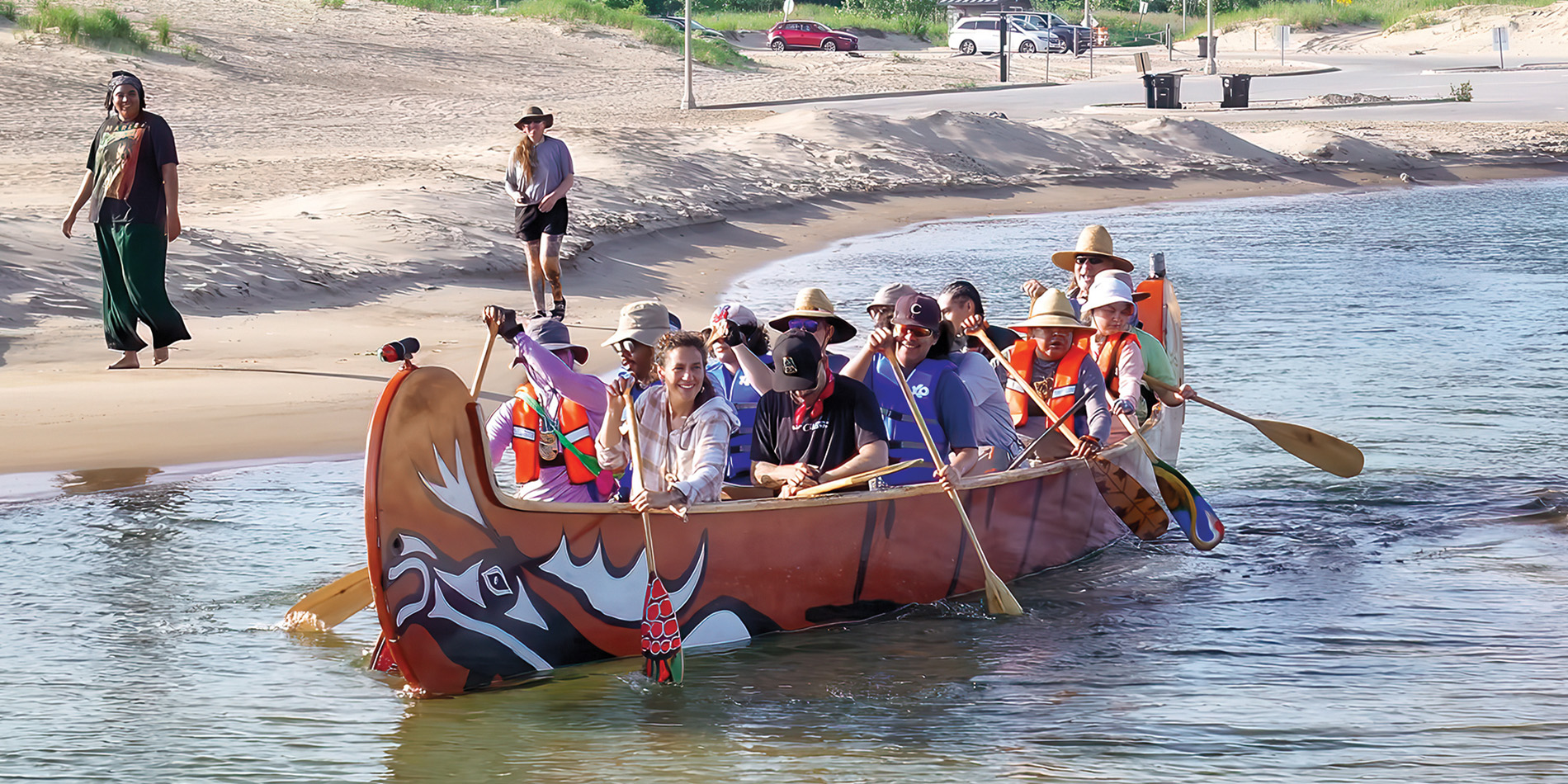
Professor Megan Bang (PhD09) and a rotating group of more than 100 other paddlers and crew traveled roughly 350 miles by canoe in July, from Chicago to Michigan’s Little Traverse Bay. They were retracing a route once traveled by the Anishinaabe, a group of culturally and linguistically related Indigenous peoples native to the Great Lakes region. Along the way, they raised awareness about Great Lakes conservation and Native water rights.
The group traveled by a single canoe, or jiimaan in Anishinaabe, from Calumet Park in Chicago, then along the Indiana and Michigan shorelines. The journey took several weeks, with paddlers covering 25 to 35 miles a day and camping at state parks each night.
“It was like time had slowed and we were in a different realm,” says Bang, describing a stretch when the lake went still and rain began to fall in rhythm with the water.
The James E. Johnson Professor of Learning Sciences at the School of Education and Social Policy, Bang helped organize the trip with Anna Lees, a University of Washington professor of learning sciences and a descendant of the Little Traverse Bay Bands of Odawa Indians. Participants also included Northwestern students, who both paddled and supported the journey on land.
“People from around the world participated,” Bang says. “It was a beautiful thing to see how we could all live well together.”
Reviving a route shaped by conflict
Anishinaabe people have long used jiimaan for travel, trade, and ceremony throughout the Great Lakes. From the 1970s through the ’90s, tribes including the Little Traverse Bay Bands of Odawa Indians fought the State of Michigan and sport fishers to uphold their treaty rights to fish in the lakes without state interference, a period Bang said still shapes tribal relationships with the water today.
The journeyu built on a tradition that dates to 2008, when the Little Traverse Bay Bands launched a youth paddle in Michigan from Petoskey to Cheboygan. More recent journeys, tied to Bang and Lees’s research on Indigenous STEAM education, have included a 2022 trip down the Des Plaines River in Illinois.
This summer’s trip coincided with renewed conflict over Canadian energy company Enbridge’s plan to build a tunnel beneath the Straits of Mackinac to carry natural gas, a project opposed by Native communities and environmental groups. Michigan regulators approved a permit for the project, and though the state supreme court later overturned that approval, the US Army Corps of Engineers has since allowed construction on the tunnel to proceed; the dispute is ongoing.
Welcomed ashore, mile by mile
At each stop, paddlers were met by crowds—some there to support the journey, others buoyed by the curiosity of encountering an expedition unlike anything seen in the region in generations, says Bang, who is Ojibwe and Italian. “We’d explain why we were doing the trip, what our treaty rights are, and who we are as peoples,” she adds, referring to the legally binding agreements between the US government and tribal nations that affirm tribal sovereignty and reserve rights such as hunting, fishing, and access to water.
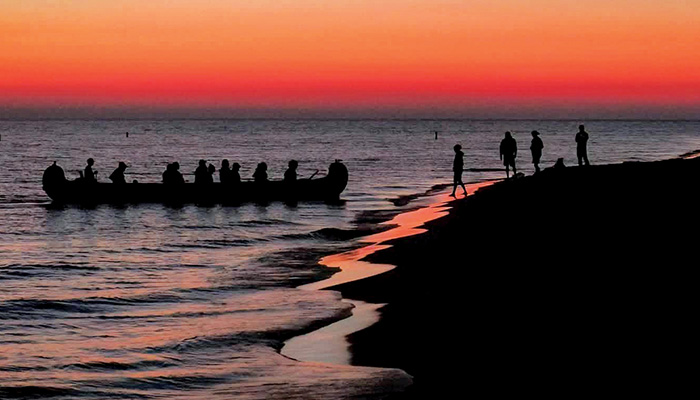
“We did this to revitalize jiimaan culture and our trade routes but also to raise awareness about climate change, learn about the lakes’ ecosystems, and continue our ancestral relationships to the water.”
“Things are hard right now, with climate, with extraction, with everything happening in the world,” Lees told Good Morning Indian Country. “It feels really important to make that visible through a journey like this and to come together and strengthen our relationships.”
Bang notes the adventure would not have happened without Fred Harrington, an elder and jiimaan caretaker who helped build the canoe and was the only paddler who traveled on every leg of the trip, including many alongside his grandson.
“Fred has the expertise to actually paddle and navigate the Great Lakes like no one else I know,” Bang says.
At times the paddlers faced wildfire smoke, headwinds, five-foot swells, and a small leak. The trip ended during a downpour at Josephine Ford Park in Harbor Springs, Michigan, where paddlers were sung ashore by supporters and elders from the Little Traverse Bay Bands.
“A returning and a receiving,” says Bang, recalling how the journey began with a song as they left Chicago. “The jiimaan journey gifted all of us so much. I’m grateful to everyone who contributed.”
By Alison Bowen
Photos by Walter Kitundu