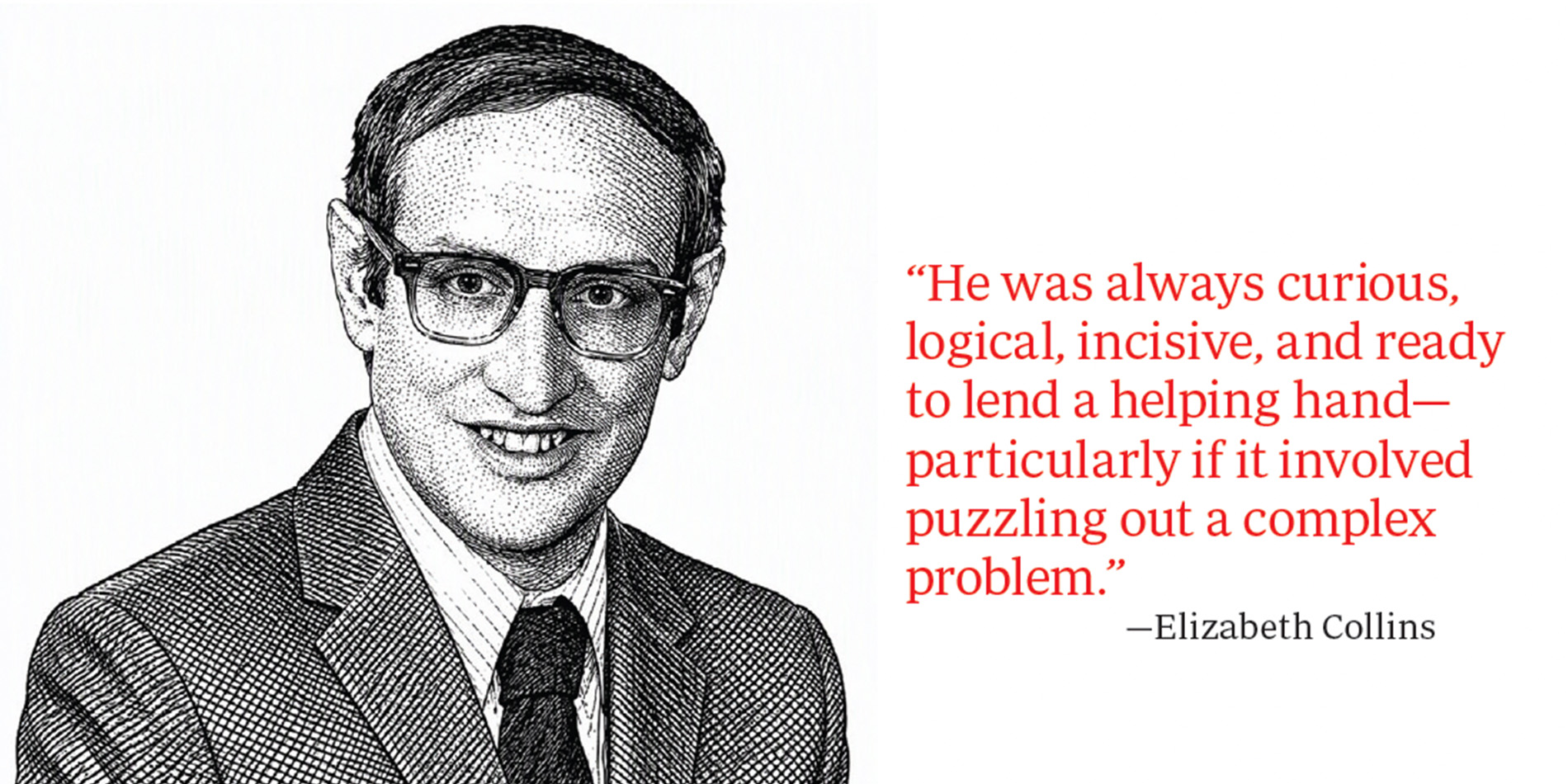
In Memoriam: Allan Collins
August 7, 1936–April 20, 2026
Allan Meakin Collins, a major force in the learning sciences and cognitive science, worked in those fields before they even had names. He became a major part of Northwestern’s Institute for the Learning Sciences, a pioneering research unit established in 1989 that anchored the development of the field. In 1991 SESP launched the nation’s first learning sciences doctoral program.
Few people have deeper roots in both fields than did Collins, says Christopher Riesbeck, associate professor of computer science at the McCormick School of Engineering and codirector of the Center for Computer Science and Learning Sciences. In fact, Collins’s work straddled several. In psychology, he was best known for concepts like semantic memory (knowing facts) and plausible reasoning (educated guessing). In AI, he researched reasoning and “intelligent” tutoring systems; in education, he studied how people learn through experience and practice.
“He was always curious, logical, incisive, and ready to lend a helping hand—particularly if it involved puzzling out a complex problem,” says his daughter, Elizabeth.
Collins earned three degrees from the University of Michigan, including a PhD in cognitive psychology in 1970. Professor emeritus Andrew Ortony, a longtime friend and colleague, was an assistant professor at the University of Illinois Urbana-Champaign when he first met Collins in 1973 at a meeting of the Psychonomics Society. They began working together and secured a multimillion-dollar grant from the National Institute of Education in 1976 to found the Center for the Study of Reading at Illinois.
When Northwestern established the Institute for the Learning Sciences with many new faculty positions in education, psychology, and computer science, both Ortony and Collins came aboard. The 1987 paper “Cognitive Apprenticeship: Teaching the Craft of Reading, Writing, and Mathematics,” coauthored by Collins, is a foundational resource and one of the reasons he was an obvious hire for the fledgling learning sciences program, Riesbeck says. Also a cofounder of the Cognitive Science Society, Collins continued his research on the use of technology in education throughout his working life.
When Penelope Peterson became dean of SESP in 1997, she met with Collins, whom she calls “one of the school’s most renowned faculty members” and a humble and gentle soul. “With Allan’s passing, our field has lost not only a groundbreaking scholar and mentor of junior faculty, but also a wonderful human being,” she says.
In 2005 Collins retired from his position as a professor of learning sciences; three years later, he was inducted as an inaugural fellow of the American Educational Research Association. He was also a member of the National Academy of Education and a fellow of the American Association for Artificial Intelligence, the Cognitive Science Society, and the American Association for the Advancement of Science.
As professor emeritus, he continued mentoring and writing articles and books. Though both retired, he and Ortony in 2022 published the second edition of their foundational 1998 book The Cognitive Structure of Emotions.
Greg Shrader, who earned his doctorate in learning sciences in 2000 at SESP and served as a research scientist at Northwestern until 2004, remembers Collins’s generosity of time. “As busy as he was, when he spoke with you, you had his full attention,” says Shrader, now CEO at Wellspring International Education. “He thrived on engaging students on topics he felt were important.”
Adds Ortony, “He was a kind, patient, and sweet man with a brilliant intellect.”