
Gary Kosman Hits the Road to Save AmeriCorps
From campus roots to national impact, Kosman built America Learns to help the helpers—and to keep service alive when it matters most
When Gary Kosman (BS00) heard about the #SaveAmeriCorps road trip in June—a grassroots effort to fight devastating federal spending cuts—his first thought was, “I have a car!” Within days, he was on the road.
Over the next month, Kosman drove through Arizona and California, interviewing AmeriCorps members and program leaders to document what could happen if the national service program, launched with bipartisan support in 1994, were eliminated. He then wrote op-eds, pitched stories to local media, and posted testimonials online to encourage grassroots action.
“AmeriCorps has been a long-standing plan B for persistently underfunded education, social service, and conservation efforts,” says Kosman, founder and CEO of software company America Learns, which works closely with AmeriCorps. “Now it’s been ripped away instantly, and there’s no plan C.”
For 25 years, Kosman has helped the helpers—volunteer and national service workers—do their jobs. Galvanized by potential AmeriCorps funding cuts, he’s now using his experience to raise awareness about the need for the program.
In April the Trump administration shuttered hundreds of AmeriCorps programs in every state, cutting off nearly $400 million in funding and instructing programs to “cease all award activities.” Immediate effects ranged from teachers losing full-time aides to flood-ravaged communities lacking long-term disaster response teams.
Funding was restored in September thanks to advocacy efforts and the help of both Democratic and Republican legislators. But the Trump administration is fighting to eliminate AmeriCorps in the 2026 budget. The Senate wants to maintain current funding levels, while the House wants to cut funding by about half and rename the program the America First Corps.
America Learns—founded as a student project—supports more than 300 AmeriCorps programs and 16 state service commissions. The company also helps universities and governments award and monitor research grants. Its secret sauce, Kosman says, is collecting data efficiently and using it in real time to provide instant professional development for frontline workers.
“Gary always had vision,” says professor Miriam Sherin. “He’d see what else was possible, how to expand a program’s reach. He also had so much drive—and energy!” Indeed, The Daily Northwestern in 1997 tapped Kosman as an “undergraduate to watch” and later observed that he “packed more into four years than most people do in a lifetime.”
James Spillane, the Spencer T. and Ann W. Olin Professor in Learning and Organizational Change, recalls how Kosman, studying social policy, was frustrated by the lack of a course on education policy and persuaded him to create one.
He showed exceptional leadership and was “the model SESP student—committed to learning about schooling and working to improve it,” Spillane says. “His ideas influenced how I thought about the social policy program long after he graduated.”
While at Northwestern, Kosman worked on the national America Reads Challenge literacy campaign, which enlisted volunteer tutors. When he saw the program lacked proper volunteer training, the idea for America Learns was sparked.
“We tutors had the best intentions but no idea what we were doing and no one to help us,” he says. “If a student brought homework we couldn’t explain, we’d often get frustrated and do it for them or send the students home with incomplete assignments.”
Having benefited himself from tutoring as a third grader in Los Angeles, Kosman was deeply discouraged. “My inner eight-year-old was screaming at me,” he says. “If we say Northwestern tutors will help, we need to deliver.” As part of an independent study and senior thesis, he developed a process to support Northwestern tutors, which he eventually developed into the software service his company licenses.
“He worked tirelessly to get funding,” Sherin recalls. “He handled design, outreach, and scaling. He was clever about making tutoring resources both useful and accessible.” When he would stop by with new ideas, faculty members would give feedback, “and he’d come back with something even better. He was impressive, with a huge heart and impact.”
After graduating in 2000, Kosman spent a year with the Coro Fellows Program in Public Affairs, honing leadership skills and learning how government, business, labor, and nonprofits intersect. When he returned to LA, he juggled three jobs while bootstrapping America Learns from coffee shops. In 2003, Echoing Green, the nation’s first social venture fund, invested in his vision.
In 2007, former president Bill Clinton mentioned America Learns in his book Giving: How Each of Us Can Change the World. Kosman’s story was later featured in Creating Good Work by Ron Schultz, who collected the wisdom of leaders in social entrepreneurship. In 2014, Kosman returned to SESP as convocation speaker, sharing insights on the power of helpful and harmful habits.
As America Learns has grown, Kosman says he is proudest of the supportive culture he’s created for clients and employees in the US, Canada, the Philippines, the Dominican Republic, and India. He established a client happiness department because “happiness is at the core of everything we do,” including a daily Five Minutes of Fun session and a culture of play.
“Gary runs a tech company, but it’s built on emotional intelligence as much as data,” says Cole McMahon, a nonprofit consultant and AmeriCorps colleague.
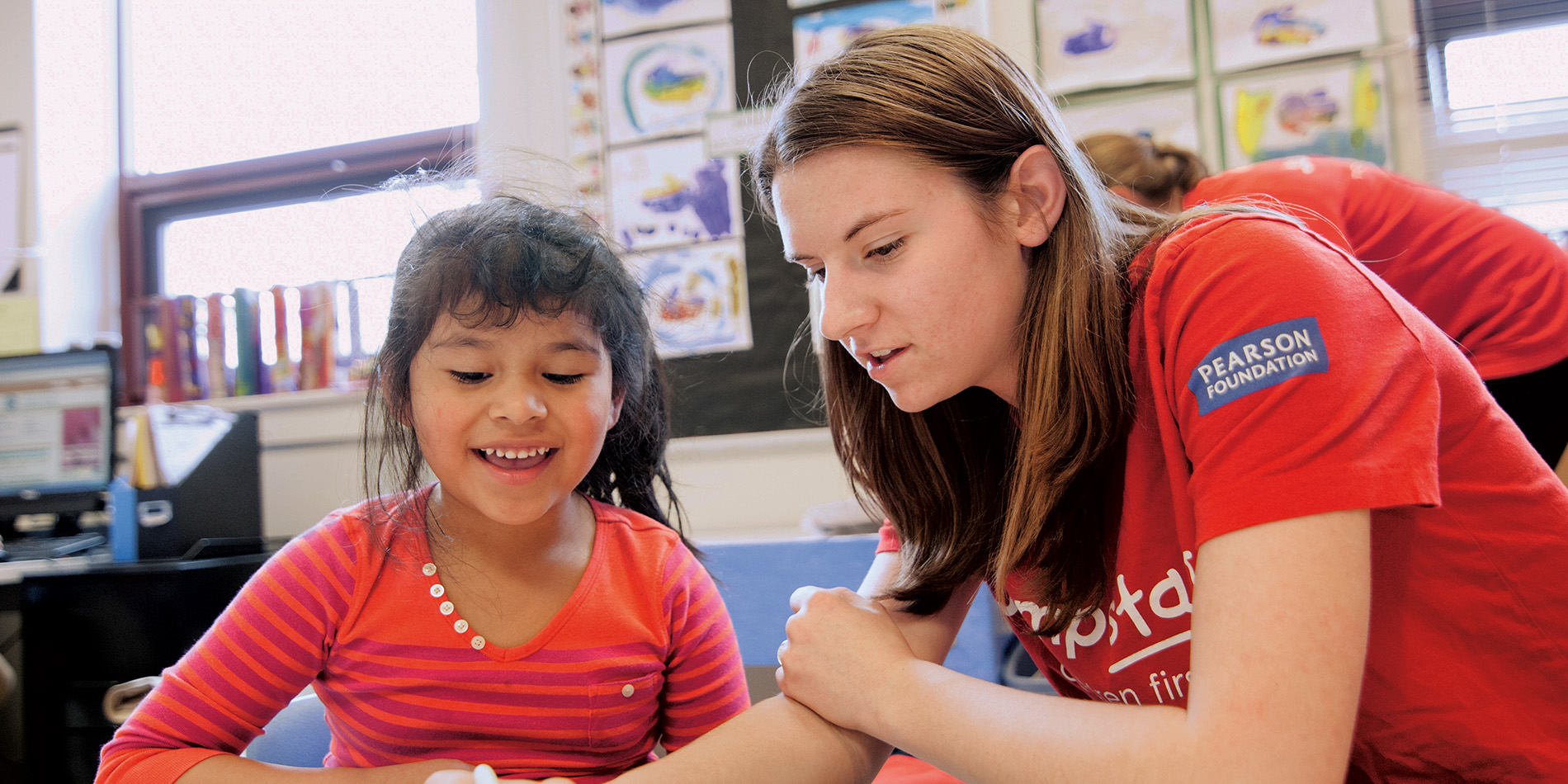
Jumpstart faces uncertain future at Northwestern
Jumpstart is a national AmeriCorps early education program that recruits and trains more than 2,000 college students annually to work in preschool classrooms to help prepare children for kindergarten.
At Northwestern, students work with preschoolers, classroom teachers, and team members at schools in Evanston and Chicago’s Rogers Park neighborhood. This year, however, the program is “under construction” due to potential cuts to AmeriCorps. While the full extent of the cuts is unclear, they are expected to significantly affect students, children, and community partners, says Rob Donahue, director and cofounder of Northwestern’s Center for Civic Engagement.
“We’re looking at severe cutbacks or even total elimination of Jumpstart at Northwestern,” he says. “Among other things, our students will likely lose access to the Segal AmeriCorps Education Awards, which we estimate have provided over half a million dollars in scholarships and loan forgiveness.”
Jumpstart supports college students serving at-risk preschool children from low-income households. Northwestern’s team contributes hundreds of hours to help children develop the language and literacy skills essential for kindergarten readiness. Senior Sara Pena Figueroa learned about Jumpstart in a child development class during her first year. Drawn to both education and working with children, she spent two years at Learning Bridge Early Education Center in Evanston.
“The whole program changed my trajectory at Northwestern,” says Figueroa, a QuestBridge scholar, Center for Civic Engagement fellow, and SESP’s Wildcat Welcome student director. “I wouldn’t be where I am without Jumpstart.”
Figueroa had wanted to teach since fifth grade, but her Jumpstart experience inspired her to make a broader impact. “I switched to social policy to drive change in the education sector beyond a single classroom,” she says.
Jumpstart operates in 13 states and the District of Columbia. Due to federal funding uncertainty, chapters have already closed at several institutions, including Boston, Georgetown, and Howard Universities. Northwestern is working with local partners to explore ways to continue supporting preschools despite the expected cuts, especially as other early childhood services like Head Start also face reductions.
Learn more about the Center for Civic Engagement’s efforts to continue serving local preschool partners and supporting student volunteers.