A Path to College
Alumna Kate Danielson helps youth in the foster system access higher education
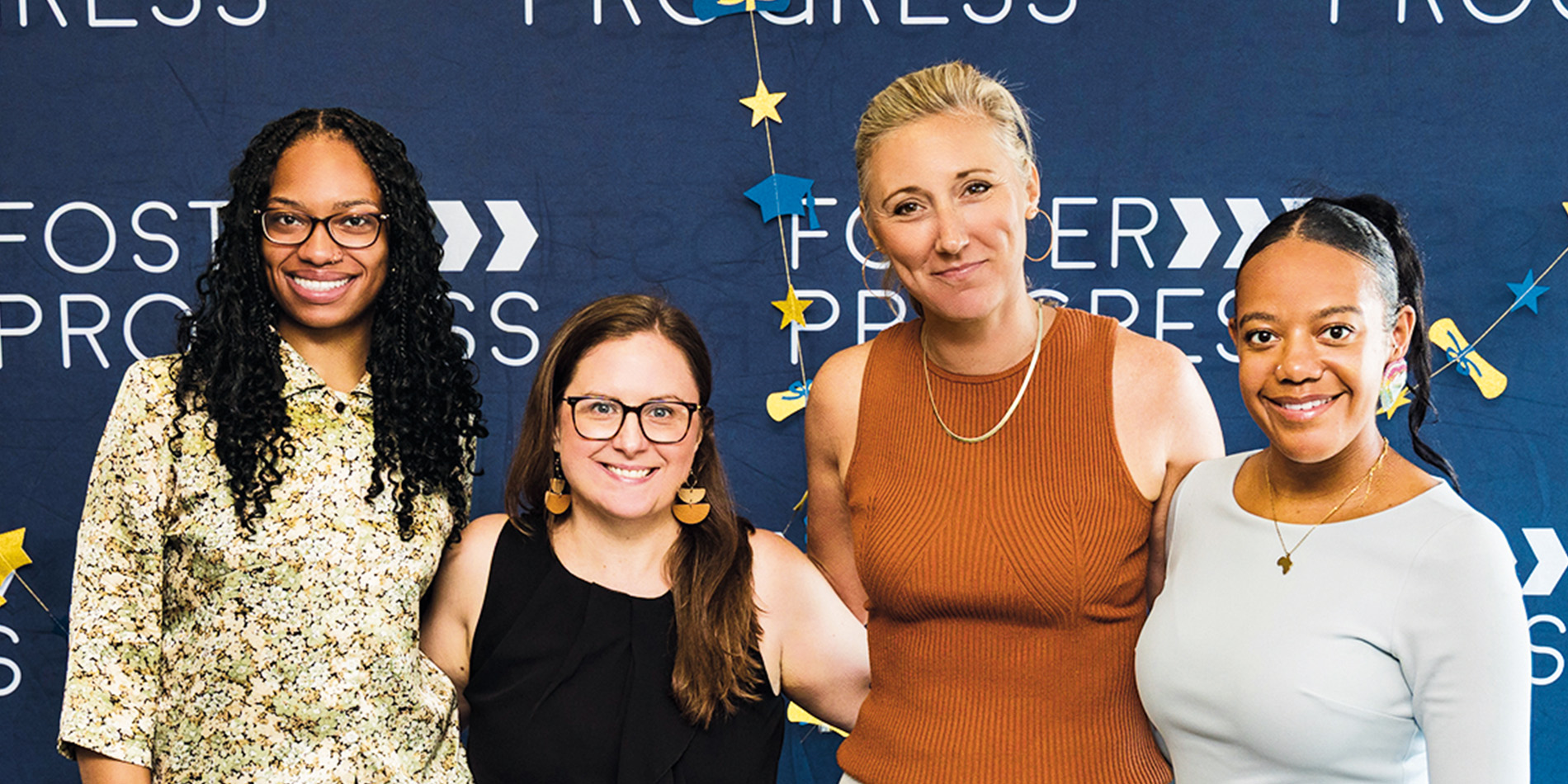
For Chicagoan Aminata Harley, the decision to take a job at Foster Progress, a nonprofit that helps teenagers in the foster care system apply to and succeed in college, felt deeply personal. That’s because Harley was once one of those teens herself.
“You just don’t know what you don’t know,” says Harley, who credits her Foster Progress mentors with helping her graduate from Bowdoin College. “Being in foster care and not having a parent means there’s a layer of basic knowledge that’s missing.”
Harley was exactly the kind of student that SESP alumna Kate Danielson hoped to reach when she founded Foster Progress in 2016. Her belief that “education is the great equalizer” has shaped her career, from teaching in public schools to running mentoring programs and ultimately founding one. Since its launch, the organization has helped more than 100 foster youth navigate the college journey and transition to adulthood.
“College is such a privilege,” says Danielson, who earned her master’s in education and social policy from SESP in 2009. “But it’s a privilege we need to open up to more people.”
The need is acute. Only 8 to 12 percent of children age 13 or older in foster care go on to earn a college degree, according to the journal AERA Open. While this is an increase from a previously reported statistic of 3 percent, there’s a long way to go to minimize the discrepancy between foster youth and those who did not experience such care, Danielson says. “Raising a teen is hard—even when they have really great foster parents—and it gets more complicated when the teen isn’t your biological child.”
Foster Progress is part of a growing group of programs offering wraparound support to help foster youth succeed in college. According to Amy Dworsky, senior researcher at Chapin Hall at the University of Chicago, these students have experienced family separation and often child abuse or neglect, unstable living arrangements, multiple caregivers, and frequent school changes—all barriers that compound the difficulty of completing a degree.
Once they get to college, many find themselves unprepared academically or socially. Schools often assume that students have homes to return to over academic breaks or family to help them move into dorms. Once they turn 21, students can lose financial support, depending on state policy. Many foster youth also come from families without college degrees.
Despite growing financial aid opportunities (expanded federal aid flexibility, state-level tuition waivers and scholarships, and a simplified FAFSA process), “there’s not a lot of the personal support,” Danielson says. The lack of support hits hardest for youth aging out of foster care, which can occur between ages 18 and 21, depending on the state.
But research shows that strong relationships and material assistance can improve how they do in school. Danielson, a mother of four children, including two adopted through foster care, began thinking about the college process during her own family’s journey.
She saw how easily foster families become stretched too thin to plan for a child’s academic success. After mentoring a young woman living in foster care who was eager to attend college, she began developing the foundation for Foster Progress.
The program has since grown from one-on-one mentoring into a robust, multipronged support system that begins when high school juniors are paired with college-educated mentors who help them make a strong finish in high school and navigate college and financial aid applications.
After each mentoring session, students earn $100 in scholarship money for postsecondary education. Social events, including visiting museums and attending lectures, strengthen mentor-mentee bonds, build cultural awareness, and encourage curiosity and critical thinking—skills that are important in college.
Consistency is key, Danielson says, because it’s often lacking in the lives of foster youth. Each June the program’s high school and college graduates are celebrated at a dinner. Once on a college campus, students can join the Youth in Care-College Advocate Program (Y-CAP), a partnership between Foster Progress and the Illinois Department of Children and Family Services that provides peer-led support groups at six Illinois colleges.
“Kate has done an amazing job of getting this program off the ground,” says Dworsky, who helped design what eventually became Y-CAP. “It could potentially be expanded to other public colleges and universities in Illinois and beyond.”
Foster Progress is also focused on advocacy work. In 2019 it helped pass legislation allowing foster children to attend public Illinois universities tuition-free, and it’s now working on a system to identify and promote foster-friendly colleges across the state.
“It benefits all of us to have an educated population who can not only provide for themselves but think for themselves,” Danielson says.
Harley, one of the first to join Foster Progress in 2017, moved into foster care with her aunt when she was 14. When she was a high school junior, an acquaintance referred her to the group. Foster Progress connected her with a mentor and financial support to apply to schools, study abroad in high school, and visit historically Black colleges and universities. Years later, her mentors flew to Maine to celebrate her graduation from Bowdoin, where she studied education, government, and legal studies.
Later, as a program assistant at Foster Progress, Harley connected with current participants and served as a relatable role model. Many students don’t know anyone else in foster care beyond their siblings, which can feel deeply isolating.
“The young people trusted me a little bit more,” she says. “Some are too shy or embarrassed to ask others even the smallest questions.” What most people don’t realize is that foster youth aren’t asking to go it alone. “Even if we seem strong or self-sufficient,” she explains, “we still need people who show up—consistently, patiently, and without judgment. That kind of support can change everything.”
For the teens she mentored, she wasn’t just a program assistant; she was living proof that their dreams are possible. “I didn’t get here by myself,” she says. “And they don’t have to, either."
--By Alina Dizik